It's late, and it's been a while since I've posted (I just realized). The long 4th of July weekend kept me busy plus I had a touch of the flu on Sunday and Monday last week, so I didn't feel like doing much of anything.
I am busy tonight, packing the car with all of the stuff I am bringing to the big NCFC gathering tomorrow at Mary Youngblood's house. I promise to take lot's of pictures and then post comments and pictures over the next couple of days about the event. We've got well over 50 people RSVP'd. Four flute makers: Geoffrey Ellis, Steven Deruby, Brian Revheim and Fairy Mushroom.
I talked to Mary today, and she's really excited about the improvization workshop tomorrow. She's bringing in a special guest to help with the workshop (I am not spoiling the surprise...). We've got Elysium Calling playing a set in the evening, starting at 6PM, and Mary also said that she's got 2/3 thirds of her band and a fill-in for the other 1/3, so there will be some special performances in the evening. It's going to be a great day. I hope to see many of you there.
If you're interested, check out the link on the NCFC website for last minute details: http://www.naflute.com/springgathering.html

Friday, July 07, 2006

Thursday, June 29, 2006
Loping Wolf Flute Circle this Sunday, July 2nd
I am on the road at the moment, so I can't post this to the NCFC calendar, but I wanted to remind everyone that the Loping Wolf Flute Clan will be hosting a flute circle this coming weekend.
Loping Wolf Flute Circle officially a NCFC Clan!!
Did I mention that we made the formal decision to adopt this wolf pack officially into the NCFC?
It's true. Dan and Sheree have shown such an enthusiast and generous spirit in their creation and coordination of the Loping Wolf Flute Circle. We've just naturally been brought together over the last couple of months.
This decision comes quite naturally for me. While we've struggled to find new leadership for the Capitol Clan over the last couple of years, and I was overly ambitious in trying to initiate the Gold Country Clan while commuting to the bay area 3-5 days a week and running things at NCFC Central. Things have not just gelled for the fluties in the greater Sacramento and foothills area. So when Dan, Sheree, Dick and Sue came along to fill a void with natural leadership, we decided to let the spirit guide where it appeared we were all headed.
So from this point forward, we are officially merging the Capitol Clan, the Gold Country Clan and the Loping Wolf Flute circle into the Loping Wolf Clan of the NCFC!! Dan DiDicco will be the official leader for the clan, but it's really a team effort with both Dan and Sheree. You can check out the Loping Wolf Clan happenings at: www.lopingwolf.com
So if have some free time on Sunday, please stop by for some fun flute playing.
The details
When: Sunday, July 2nd. Noon - ???
What to bring: Flutes and other musical instruments. Potluck dish and something to BBQ.
Where: Lake of the Pines, near Auburn CA
How: RSVP by sending an email to Dan DiCicco: flutecircle AT lopingwolf DOT com
Dan will add you to the gate list and send you directions directly.
Loping Wolf Flute Circle officially a NCFC Clan!!
Did I mention that we made the formal decision to adopt this wolf pack officially into the NCFC?
It's true. Dan and Sheree have shown such an enthusiast and generous spirit in their creation and coordination of the Loping Wolf Flute Circle. We've just naturally been brought together over the last couple of months.
This decision comes quite naturally for me. While we've struggled to find new leadership for the Capitol Clan over the last couple of years, and I was overly ambitious in trying to initiate the Gold Country Clan while commuting to the bay area 3-5 days a week and running things at NCFC Central. Things have not just gelled for the fluties in the greater Sacramento and foothills area. So when Dan, Sheree, Dick and Sue came along to fill a void with natural leadership, we decided to let the spirit guide where it appeared we were all headed.
So from this point forward, we are officially merging the Capitol Clan, the Gold Country Clan and the Loping Wolf Flute circle into the Loping Wolf Clan of the NCFC!! Dan DiDicco will be the official leader for the clan, but it's really a team effort with both Dan and Sheree. You can check out the Loping Wolf Clan happenings at: www.lopingwolf.com
So if have some free time on Sunday, please stop by for some fun flute playing.
The details
When: Sunday, July 2nd. Noon - ???
What to bring: Flutes and other musical instruments. Potluck dish and something to BBQ.
Where: Lake of the Pines, near Auburn CA
How: RSVP by sending an email to Dan DiCicco: flutecircle AT lopingwolf DOT com
Dan will add you to the gate list and send you directions directly.
Tuesday, June 27, 2006
Soon You May Have To Pay For Every Time Your Computer Caches A Song Copy
I found an interesting article about some pending legislation that would add new ways for copyright holders to enforce licensing agreements on music:
"It would require all incidental copies of music to be licensed separately from the originating copy. Even copies of songs that are cached in your computer's memory or buffered over a network would need yet another license.
"It would require all incidental copies of music to be licensed separately from the originating copy. Even copies of songs that are cached in your computer's memory or buffered over a network would need yet another license.
INAFA Conference Volunteers page online
We just posted a webpage highlighting the volunteer opportunities at the upcoming INAFA Conference in Belmont, CA (in the Bay Area). On this webpage, you'll find a listing of all of the tasks for which we need some volunteer help during the week of the INAFA Conference. As host circle, we committed to helping make this event happen.
As a thank you to our volunteers, we will have a "volunteers raffle" at the end of the INAFA event. The volunteers webpage highlights the 'thank you' prizes. As a volunteer, you will earn a raffle ticket for each hour which you volunteer and work at the event.
If you happen to be a vendor reading this, we'd like to encourage you to donate a prize to the volunteer raffle. Contact Mike Oitzman: ncfc AT naflute DOT com
As a thank you to our volunteers, we will have a "volunteers raffle" at the end of the INAFA event. The volunteers webpage highlights the 'thank you' prizes. As a volunteer, you will earn a raffle ticket for each hour which you volunteer and work at the event.
If you happen to be a vendor reading this, we'd like to encourage you to donate a prize to the volunteer raffle. Contact Mike Oitzman: ncfc AT naflute DOT com
Monday, June 26, 2006
Final days to Register for INAFA Conference
 If you haven't done so already, the last day to register for the 2006 INAFA Conference for the $50 registration fee is this FRIDAY, June 30th. After that you can still register on the first day of the conference for $75 cash. By the way, the evening concert ticket prices for the INAFA Conference have been set, the price will be $15 per person.
 I know several local bay area folks who have to work and can't attend the Thursday/Friday workshops, but would like to attend the evening concert. At the $15 concert ticket price, it might be worth registering for the $50 and save $10 bucks, and still get to attend the workshops and hang out on Saturday and Sunday.
Friday, June 23, 2006
Friday Fun: Pianolina
I've got something fun and entirely unflute related for you today. However, it is still musical... and those of you who know me, you know I love to experiment with anything that makes sound.
So check this out, it's an online, experimental piano interface called Pianolina. You get to experiment with sound and control the piano in a way you've never done before.
It takes a while to get the hang of, but the results are pretty cool. Just keep clicking on stuff until you figure it out. Hit the reset button on the interface to start over...
oh yeah, and if you find a melody that you like, try playing your flute along with it...
here's the link: http://www.grotrian.de/spiel/e/info.html
So check this out, it's an online, experimental piano interface called Pianolina. You get to experiment with sound and control the piano in a way you've never done before.
It takes a while to get the hang of, but the results are pretty cool. Just keep clicking on stuff until you figure it out. Hit the reset button on the interface to start over...
oh yeah, and if you find a melody that you like, try playing your flute along with it...
here's the link: http://www.grotrian.de/spiel/e/info.html
Thursday, June 22, 2006
Playing TIp #23: Flute Keys
In general, a key or scale is a set of notes that sound consonant with one another and from which the bulk of the notes in a song are chosen. In modern western music theory, this pool of notes is defined by partitioning an octave into 12 equally spaced notes (defined as a half step) between any two neighboring octaves. It’s not the intent of this posting to dive deeply into musical theory, however it is important to understand a few fundamentals of musical notation in order to have a reference for some subsequent discussion. Why is this important? One of the most common questions for new flute player is: What is the key of my flute? This discussion will help answer that question.
Basic Notes
For lack of any better reason in the organization of these possible notes, each note has been assigned a letter name from A to G. For example, all of the white keys on a piano are assigned one of these letters repetitively in order from A to G. In addition, there is also the concept that some notes are slightly higher or lower than any given note. When a note is slightly higher, it is called a “sharp” and denoted with the symbol: #. Likewise, when a note is slightly lower, it is called a “flat” and denoted with the symbol: b (lowercase B). All of the black keys on a piano are designated as sharps or flats. These notes can alternatively be called either the sharp of the note immediately below it, or the flat of the note immediately above it**
Here is the complete list of these 12 notes, in order:
A, A#(Bb), B, C, C#(Db), D, D#(Eb), E, F, F#(Gb), G, G#(Ab)
The bottom line is that the fundamental note (the note played with all holes covered) of your flute is one of these twelve notes, and the subsequent scale produced by the other holes on the flute will be in a scale related to this fundamental note. There are many, many types of scales that can be played on most instruments, however some of these scales are more pleasing to listen to than others. ThIn a future post, I will introduce the pentatonic scale, which has become the scale of choice for most modern Native American Flute makers today, and give you some ideas of the other scales which can be found on your flute.
**In classical musical theory there are some strict guidelines about this rule of assigning sharps and flats, but we won’t concern ourselves with this in this discussion. It’s enough to know that sometimes a note can be called two different things and mean the same thing.

This Playing Tip is licensed under a Creative Commons Attribution-NonCommercial-ShareAlike 2.5 License.
Basic Notes
For lack of any better reason in the organization of these possible notes, each note has been assigned a letter name from A to G. For example, all of the white keys on a piano are assigned one of these letters repetitively in order from A to G. In addition, there is also the concept that some notes are slightly higher or lower than any given note. When a note is slightly higher, it is called a “sharp” and denoted with the symbol: #. Likewise, when a note is slightly lower, it is called a “flat” and denoted with the symbol: b (lowercase B). All of the black keys on a piano are designated as sharps or flats. These notes can alternatively be called either the sharp of the note immediately below it, or the flat of the note immediately above it**
Here is the complete list of these 12 notes, in order:
A, A#(Bb), B, C, C#(Db), D, D#(Eb), E, F, F#(Gb), G, G#(Ab)
The bottom line is that the fundamental note (the note played with all holes covered) of your flute is one of these twelve notes, and the subsequent scale produced by the other holes on the flute will be in a scale related to this fundamental note. There are many, many types of scales that can be played on most instruments, however some of these scales are more pleasing to listen to than others. ThIn a future post, I will introduce the pentatonic scale, which has become the scale of choice for most modern Native American Flute makers today, and give you some ideas of the other scales which can be found on your flute.
**In classical musical theory there are some strict guidelines about this rule of assigning sharps and flats, but we won’t concern ourselves with this in this discussion. It’s enough to know that sometimes a note can be called two different things and mean the same thing.
This Playing Tip is licensed under a Creative Commons Attribution-NonCommercial-ShareAlike 2.5 License.
Wednesday, June 21, 2006
Elysium Calling to join us for the Spring Gathering
 I just got confirmation that our friends Garth and Kenneth of Elysium Calling will join us for the evening at Mary Youngblood's house for the annual NCFC Spring Gathering. If you haven't had the chance to hear Garth & Kenneth play live before, you're in for a real treat. We've invited Elysium Calling to play a set of their music as we get things going on stage after dinner. I hear that they're working on some new songs, and they've never been shy about sharing their 'works in progress" with us. Garth will also stay on stage for a while to play improvized guitar with anyone who'd like to step up and play along, applying the concepts and tips that we'll learn at Mary's Improvization workshop earlier in the day. By the way, if you haven't RSVP'd for this event yet, you need to do so now. The workshops are filling up.
Tuesday, June 20, 2006
Mary Youngblood article in Sac Bee
There is a great article/interview in the Sac Bee today with Mary Youngblood. In the article, Mary talks about her transition to include and play more instruments than simply the flute on her CD's. She also talks about her new band: Sisters of the Earth, and the evolution to playing music as a group rather than solo. Sisters of the Earth are playing this weekend at the Cottonwood Wild West Wine and Art Festival in Cottonwood.
The article is currently here: http://www.sacticket.com/music/story/14269514p-15080588c.html
Thanks to Francesca for passing along this note!!
The article is currently here: http://www.sacticket.com/music/story/14269514p-15080588c.html
Thanks to Francesca for passing along this note!!
CD Review: Spirit Romance
 I recently purchased the album Spirit Romance which was released this last fall by pianist David Lanz and flutist Gary Stroutsos. These guys are two of my favorite new age artists, and I was really excited to hear them together. David Lanz has been in my CD player since I purchased his album "Christophori's Dream" so many years ago.
 I fell in love with Gary's music when he visited Northern California 6 years ago and put on an advanced flute workshop and concert for the NCFC. On this album, Gary plays the Chinese bamboo Xiao, an end-blown Chinese flute which has rarely been recorded outside of China or in non-Chinese music. It's mystical sounding flute, and one which I think that you will enjoy.
The album also features Keith Lowe on acoustic bass, keyboardist John Serrie and Glen Velez on hand drums.
Note that Gary Stroutsos will be on stage in No Cal in August 2006 at the INAFA Convention along with Will Clipman, so those of you who attend the convention will be able to hear him live! You can also download a podcast (or listen to the MP3 file on your computer) of an interview with Gary and David on the Mystic Soundscapes internet radio program.
Even though there is no Native American Flute featured on this album, this album gets heavy rotation in my iPod. This is an excellent album for the office or a nice quiet dinner party.
I give it 5 out of 5 stars.
Serenada
The incredible piano intro in this song simply floats you away. The melody is what I would call “classic David Lanz”, but when combined with Gary’s flute it’s even more entrancing. A classic.
Satori
This is a majestic tune which reminds me of a river trip through a primordial rain forest. Drums by Glen Velez accent the tune nicely. This is one of my favorite tunes on the CD.
Between Worlds
This is an ethereal piano tune, a nice relaxing and drifting melody.
Blue Largo
Great back beat on this one. Glen Velez plays the Eqyptian Riq, a tambourine like instrument that I am struggling to master. The Xiao is featured front and center, demonstrating it’s rich tone along side the piano.
Spirit Romance
The flute leads this song from the beginning. The piano dances with the flute, swirling around and around. Violin adds a nice rounding the song. No matter what I am doing, when this song plays, I have to close my eyes and relax for a moment.
Soliloquy
The breathy flute intro on this song will steal your heart. Gary exhibits the breadth of sonic possibilities with the Xaio flute on this solo.
A Distant Light
This is my favorite song on the CD. The interplay of piano and flute on this song are in perfect balance. Glen Velez play the Riq, one of my favorite frame drums, in the classical form. John Serrie provides the background. This song and the next four all blend together on one big long journey.
Dreams of Altair, Contemplation, Compassion
These songs features space musician John Serrie, who also played on the original “Wings to Altair” on Christophori’s Dream. On Compassion the solo Xiao, spiced with just enough “space” is a powerful tune. I really like the long notes of the Xiao here.
The Return
The Return brings the suite to closure, and for the David Lanz fans out there, you get a nice hint of the original inspiration of “Wings to Altair”.
http://davidlanz.com/spirit.htm
http://www.garystroutsos.com/spiritRomanceArticle03.htm
Monday, June 19, 2006
Check out Scott August's Blog
Just a quick shout out to Scott August, who's also been blogging a lot in the last couple month's. If you haven't been checking out his blog, you should: http://cedarmesa.blogspot.com/
And by the way, if you don't own any of Scott's CD's, you're missing out on some of the best Native American Flute music out there...
And by the way, if you don't own any of Scott's CD's, you're missing out on some of the best Native American Flute music out there...
Volunteer Information for INAFA coming soon!
STAY TUNED...
We are in the final week of planning the volunteer needs for the upcoming INAFA Conference in Belmont in August. Once we have the list of volunteer tasks complete and the schedule of days for the volunteer needs, we'll notify everyone who was interested in volunteering. I'll definitely post here when the INAFA volunteer website link is active.
I will tell you that we're planning a "Volunteer Raffle" to say thank you to the volunteers. If you volunteer your time, you'll earn raffle tickets for this raffle to be held on the last day of the conference. If you are vendor/flute maker and you would like to contribute to the INAFA Volunteer Raffle, please send an email to ncfc AT naflute DOT com
THANKS!
We are in the final week of planning the volunteer needs for the upcoming INAFA Conference in Belmont in August. Once we have the list of volunteer tasks complete and the schedule of days for the volunteer needs, we'll notify everyone who was interested in volunteering. I'll definitely post here when the INAFA volunteer website link is active.
I will tell you that we're planning a "Volunteer Raffle" to say thank you to the volunteers. If you volunteer your time, you'll earn raffle tickets for this raffle to be held on the last day of the conference. If you are vendor/flute maker and you would like to contribute to the INAFA Volunteer Raffle, please send an email to ncfc AT naflute DOT com
THANKS!
Classifieds LIVE on NCFC website
We've initiated the Classifieds section of the NCFC website again. Check it out here: http://www.naflute.com/classifieds.html
Here's the simple rules for the classifieds section
Here's the simple rules for the classifieds section
- Non-commercial submission of ads is free for members.
- Non-member and commercial submissions (i.e. vendors) are $5 per two-week period.
- Send your text submission, including contact information (max 250 characters) to: classifieds AT naflute DOT com
- Ad content will be updated/published on the first and third Mondays of the month, and will persist for two weeks, unless a subsequent submission is made prior to the publication date.
Tuesday, June 13, 2006
News from the Auburn Confluence Festival
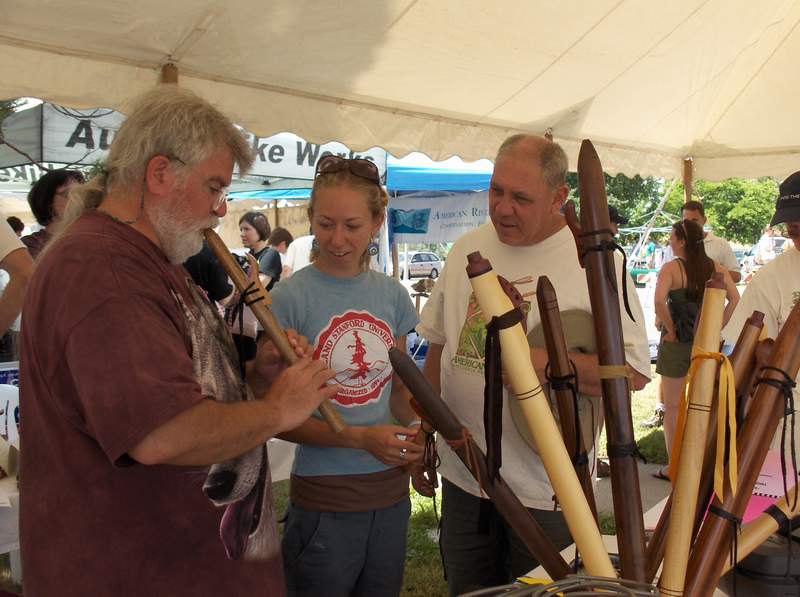 I had a wonderful time on Sunday at the Confluence Festival in Auburn. I joined Dan DiCicco, Sheree DiCicco, Dick & Sue and the rest of the Loping Wolf Flute circle in their flute booth. We talked to folks all afternoon, sold some flutes, played LOTS of flutes and generally had a great time.
This was the first event for the Loping Wolf flute Circle to have a booth, and I think that it was a roaring sucess. Loping Wolf were invited to participate in the opening ceremonies for the event where they played Zuni Sunrise together. Unfoturnately I was unable to make it there early enough to hear them, but everyone said it was wonderful.
In the picture above, you can see Dan DiCicco demostrating a flute for a couple of folks, I didn't see Dan sit down the whole day. We had Mary Youngblood's new CD "Dance with the Wind" for sale, and I finally got my very own copy!! It's awesome. I listened to it all day yesterday at work. Look for a future post where I'll do a review of this CD.
Below you can see picture of the Loping Wolf flute circle and their booth.
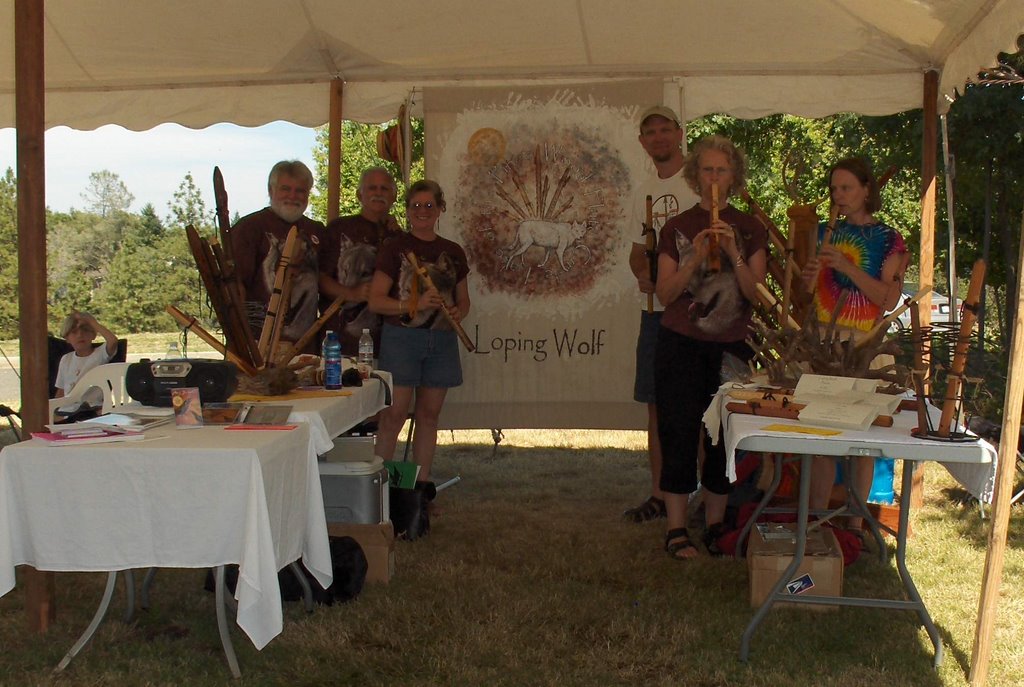
Sunday, June 11, 2006
Bay Area Museums featuring Native American exhibits
Looking for something to do with friends or relatives visiting the Bay Area this summer?
Check out the following museums with special exhibits:
The Phoebe A. Hearst Museum of Anthropology at USB has an exhibit: Native Californian Cultures on display now
SPIRIT SPEAKS: Contemporary and Historic Expressions of Native Peoples, presented by the Marin Arts Council, now through October 7 2006
June 18th: Native Contemporary Arts Festival at Yerba Buena Gardens
Check out the following museums with special exhibits:
The Phoebe A. Hearst Museum of Anthropology at USB has an exhibit: Native Californian Cultures on display now
SPIRIT SPEAKS: Contemporary and Historic Expressions of Native Peoples, presented by the Marin Arts Council, now through October 7 2006
June 18th: Native Contemporary Arts Festival at Yerba Buena Gardens
American River Confluence Festival Today
 If you're near Auburn today, be sure to check out the American River Confluence Festival. The Loping Wolf Flute Circle will be apart of the opening ceremonies and we'll all be hanging out at the Loping Wolf booth, so stop by and say hi and bring your flutes or drums for a little informal jamming.
Friday, June 09, 2006
Weekly Standford drum circle
There's a great drum circle taking place every Friday night at Stanford University now. They welcome other instruments including didjs and Native American Flute (although it can get loud)
Weekly Drum Circle
Fridays
7:30 pm - 10:00 pm (This event repeats every week, until Tuesday October 31, 2006.)
Event Location: Papua New Guinea Sculpture Garden @ Stanford
Notes:
Stanford University, papua new guinea sculpture garden
Friday nights starts around 7:30pm
louder drumming will end at 10pm
bring a chair seating can be scarce
Directions:
Santa Teresa Street (off Campus Drive West) and Lomita Drive, near Roble Hall.
From 280 Page Mill Road exit head east left at 2nd traffic light onto junipero serra right at 3rd traffic light onto campus drive west right at 1st stop sign unto santa teresago through one stop sign the sculpture garden is at the corner at the 2nd stop sign at the intersection of santa teresa and lomita drive
Weekly Drum Circle
Fridays
7:30 pm - 10:00 pm (This event repeats every week, until Tuesday October 31, 2006.)
Event Location: Papua New Guinea Sculpture Garden @ Stanford
Notes:
Stanford University, papua new guinea sculpture garden
Friday nights starts around 7:30pm
louder drumming will end at 10pm
bring a chair seating can be scarce
Directions:
Santa Teresa Street (off Campus Drive West) and Lomita Drive, near Roble Hall.
From 280 Page Mill Road exit head east left at 2nd traffic light onto junipero serra right at 3rd traffic light onto campus drive west right at 1st stop sign unto santa teresago through one stop sign the sculpture garden is at the corner at the 2nd stop sign at the intersection of santa teresa and lomita drive
Thursday, June 08, 2006
Playing Tip #22: Places to play
You don’t have to look far to find a place to play your flute. However, I’ve found the most inspiring places are those where nature has an influence on my mood. Acoustics is another important consideration, especially as you practice. Don’t be surprised if, while playing in place like a stairwell or hallway, some notes are amplified more than others. It means that the room is “tuned” for the amplitude of the note that you just played. For example the stairwell in my last house was tuned to an “A”, and whenever I hit an “A” note on any of my flutes it this note was naturally amplified.
Outside
I think that the Native American Flute is most inspiring to play outside. Whether your inspiration is found in the trees, a robin bouncing along in the grass or the rising moon, nature will speak to you when you play the flute if you open your eyes and ears to it.
When playing outside, it’s important to realize that the wind (any breeze) will affect the ability of the flute to make a sound. If there is enough of a breeze, your flute might not make any sound at all. This is because the breeze blowing across the top of the flute may negate the ability of the air to vibrate effectively within the flute. You can minimize this effect by turning your back to the wind/breeze, but it is impossible to remove all of the wind effects.
Temperature is another important factor. I don’t recommend playing outside in any temperature below about 65º F. As the temperature drops below your body temperature, you experience more dramatic “watering-out” of the flute, to the point where the flute will not make a sound (regardless of whether there is any breeze). It is also important to try to keep your wooden flutes in the temperature range between 65º and 95º (or body temperature). Remember this when traveling with your flutes in the car or backpacking.
Some of the most exciting places that I have played my flute have been caves and canyons where you can experience a natural echo to your playing. If you find yourself in an urban setting, don’t forget that there are a lot of cement canyons and caves to experiment with.
Stairwells & Parking Structures
In the absence of a canyon or cave, a stairwell can produce a pretty exciting natural amplification of your flute. Try it in your office building, or the next time you stay in a hotel. I’ve even taken my flute out and played in a parking garage. Soon you’ll find yourself searching for these interesting acoustic experiences.
Bathroom
Of course I can’t forget to mention one of the man-made caves that we all have in our houses. Interestingly enough, the bathroom is a great place to submit your self to a natural acoustic phenomenon. Just like “singing in the shower” makes us all sound like professional singers, playing your flute in the bathroom is a great acoustic experience. To increase the echo, try taking all of the towels off the towel racks, take the shower curtain down and the bath rug off the floor (if your bathroom is not carpeted). Oh, and did I mention that it also comes equipped with comfortable seating?
What's your favorite place to play? [Leave a comment...]
This Playing Tip is licensed under a Creative Commons Attribution-NonCommercial-ShareAlike 2.5 License.
Outside
I think that the Native American Flute is most inspiring to play outside. Whether your inspiration is found in the trees, a robin bouncing along in the grass or the rising moon, nature will speak to you when you play the flute if you open your eyes and ears to it.
When playing outside, it’s important to realize that the wind (any breeze) will affect the ability of the flute to make a sound. If there is enough of a breeze, your flute might not make any sound at all. This is because the breeze blowing across the top of the flute may negate the ability of the air to vibrate effectively within the flute. You can minimize this effect by turning your back to the wind/breeze, but it is impossible to remove all of the wind effects.
Temperature is another important factor. I don’t recommend playing outside in any temperature below about 65º F. As the temperature drops below your body temperature, you experience more dramatic “watering-out” of the flute, to the point where the flute will not make a sound (regardless of whether there is any breeze). It is also important to try to keep your wooden flutes in the temperature range between 65º and 95º (or body temperature). Remember this when traveling with your flutes in the car or backpacking.
Some of the most exciting places that I have played my flute have been caves and canyons where you can experience a natural echo to your playing. If you find yourself in an urban setting, don’t forget that there are a lot of cement canyons and caves to experiment with.
Stairwells & Parking Structures
In the absence of a canyon or cave, a stairwell can produce a pretty exciting natural amplification of your flute. Try it in your office building, or the next time you stay in a hotel. I’ve even taken my flute out and played in a parking garage. Soon you’ll find yourself searching for these interesting acoustic experiences.
Bathroom
Of course I can’t forget to mention one of the man-made caves that we all have in our houses. Interestingly enough, the bathroom is a great place to submit your self to a natural acoustic phenomenon. Just like “singing in the shower” makes us all sound like professional singers, playing your flute in the bathroom is a great acoustic experience. To increase the echo, try taking all of the towels off the towel racks, take the shower curtain down and the bath rug off the floor (if your bathroom is not carpeted). Oh, and did I mention that it also comes equipped with comfortable seating?
What's your favorite place to play? [Leave a comment...]
This Playing Tip is licensed under a Creative Commons Attribution-NonCommercial-ShareAlike 2.5 License.
Tuesday, June 06, 2006
Spring Voice of the Circle now online
I posted the Spring 2006 Voice of the Circle newsletter for the NCFC online this morning. Highlights in this newsletter include:
- INAFA Update
- Annual NCFC Gathering
- Vince Redhouse Event
- New Flutemaker Discount program
Paper versions will be mailed this weekend.
I am still working on new membership badges, but the good news is that we now have a graphic artist who is helping us with artwork for the NCFC. Mary-Ann Myers has volunteered her services for the benefit of the circle. I am working with Mary-Ann to get the artwork completed fo the new badges. A special thanks to Mary-Ann.
Clarification on Butch Hall flute tunings
On a earlier post I mentioned that Butch Hall flutes are typically tuned with an extended scale tuning. This tuning allows the flute to have an extended upper range, but it doesn't use the 'traditional" mode 1/mode 4 fingering.
I wrote Laura Hall an email to inquire about their flutes and fingering and here's what Laura wrote back:
"we make 4 flutes in the "traditional" mode 1/mode 4 tuning: our high Bm Little Bird at $49, our high Am Little Horse at $49, our Gm Le Mita Cola at $55 for spanish cedar (while a few remain in stock), $65 for eastern red cedar (due out of the finish room in 2-3 weeks, and the new standard), and our bass Cm in spanish cedar at $225.
I have often said that the Little Horse is the "Best Flute under $50" - with the traditional tuning, making it an excellent investment as an entry level instrument for a beginning flute player. I now have to add the Little Bird to that same category, although I would recommend the Little Horse over the Little Bird since it's in the more common key of A.
I wrote Laura Hall an email to inquire about their flutes and fingering and here's what Laura wrote back:
"we make 4 flutes in the "traditional" mode 1/mode 4 tuning: our high Bm Little Bird at $49, our high Am Little Horse at $49, our Gm Le Mita Cola at $55 for spanish cedar (while a few remain in stock), $65 for eastern red cedar (due out of the finish room in 2-3 weeks, and the new standard), and our bass Cm in spanish cedar at $225.
I have often said that the Little Horse is the "Best Flute under $50" - with the traditional tuning, making it an excellent investment as an entry level instrument for a beginning flute player. I now have to add the Little Bird to that same category, although I would recommend the Little Horse over the Little Bird since it's in the more common key of A.
Monday, June 05, 2006
Tentative INAFA Conference Schedule now online
INAFA has posted the tentative schedule for the upcoming convention in August. It includes the workshops and evening concert schedule. Check it out online: http://www.inafa.org/convschedule2006.pdf
Here's the evening concert schedule:
Tickets will be avaiable each evening on a first come first served basis. We don't have evening concert ticket prices yet, but you might be better off just purchasing the $50 registration fee which includes all the evening concerts. That way you're guaranteed a seat!!
Wed, August 2:
- Xavier Quijas Yxayotl
- Charles Littleleaf
- Ash Dargan with Jeremy Donovan
Thursday, August 3:
- Evren Ozan
- The Vince Redhouse Group
- Peter Phippen with Jonathan Hull and Jared Pool
Friday, August 4:
- Gary Stroutsos with Will Clipman
- Michael Graham Allen (Coyote Oldman)
- Mark Holland with Autumn’s Child
Saturday, August 5:
- Hovia Edwards
- Jeff Ball
- R. Carlos Nakai
Here's the evening concert schedule:
Tickets will be avaiable each evening on a first come first served basis. We don't have evening concert ticket prices yet, but you might be better off just purchasing the $50 registration fee which includes all the evening concerts. That way you're guaranteed a seat!!
Wed, August 2:
- Xavier Quijas Yxayotl
- Charles Littleleaf
- Ash Dargan with Jeremy Donovan
Thursday, August 3:
- Evren Ozan
- The Vince Redhouse Group
- Peter Phippen with Jonathan Hull and Jared Pool
Friday, August 4:
- Gary Stroutsos with Will Clipman
- Michael Graham Allen (Coyote Oldman)
- Mark Holland with Autumn’s Child
Saturday, August 5:
- Hovia Edwards
- Jeff Ball
- R. Carlos Nakai
Thursday, June 01, 2006
Don't miss: Berkeley World Music Festival
This weekend, June 3-4, 2006 in Berkeley, it looks like there will be non-stop world music going on all around town. And it's all free!
Don't miss Steven Kent on didjeridoo, if you happen to see him.
Check it out: http://www.berkeleyworldmusic.org/
Don't miss Steven Kent on didjeridoo, if you happen to see him.
Check it out: http://www.berkeleyworldmusic.org/
NCFC Calendar updated!
 We've just added the second half of the 2006 Northern California Flute Circle calendar of events (June - Dec) to the NCFC Calendar. Log on to check out what's happening in the flute world for Northern California and beyond.
Mary Youngblood has a new Myspace website
Mary Youngblood has a new myspace website at: http://www.myspace.com/maryyoungblood
You can listen to streaming music off of her latest album "Dance with the wind"
You can listen to streaming music off of her latest album "Dance with the wind"
Playing tip #21: Composition
This is the sixth exercise in the series of duet exercises, designed to provide you with some new ideas when playing with another flute player. This is an intermediate exercise, so if you are a beginner, I recommend that you start with the earlier exercises posted on prior weeks playing tips.
Description
This exercise builds on the ideas introduced in the prior exercises. The variable in this exercise is that both flute players will harmonize by playing different, but harmonious, phrases at the same time. There are not many rules to this exercise but the key to success is establishing one player as the lead and the other player as harmony. These roles can be switched (deliberately) during the course of the song. If you have been following along with the prior exercises over the last twomonth'ss, then you are ready for this.
Tip #1
Stay in the pentatonic scale and occasionally have both players linger together on the same note, as this is a good place to switch roles or bring your independent paths together for a moment.
Tip #2
Having one player establish the general theme to the song is a good practice. Bouncing around this theme or phrase is good way to keep things organized and in a frame of reference that is easier to harmonize with.
Tip #3
When you first attempt this with a new player, be sure to face each other and watch each others eyes. The subtle communication without words is a good watch to pass the lead role between each other. A nod or a wink is a one way to pass the lead.
This Playing Tip is licensed under a Creative Commons Attribution-NonCommercial-ShareAlike 2.5 License.
Description
This exercise builds on the ideas introduced in the prior exercises. The variable in this exercise is that both flute players will harmonize by playing different, but harmonious, phrases at the same time. There are not many rules to this exercise but the key to success is establishing one player as the lead and the other player as harmony. These roles can be switched (deliberately) during the course of the song. If you have been following along with the prior exercises over the last twomonth'ss, then you are ready for this.
Tip #1
Stay in the pentatonic scale and occasionally have both players linger together on the same note, as this is a good place to switch roles or bring your independent paths together for a moment.
Tip #2
Having one player establish the general theme to the song is a good practice. Bouncing around this theme or phrase is good way to keep things organized and in a frame of reference that is easier to harmonize with.
Tip #3
When you first attempt this with a new player, be sure to face each other and watch each others eyes. The subtle communication without words is a good watch to pass the lead role between each other. A nod or a wink is a one way to pass the lead.
Tip #4
This is as much a listening exercise as it is a playing exercise. Harmony can only be created when you are in sync with the other player and when you know your instrument well. Make sure that you listen to what the other player is playing, listen the pattern they are playing and try to anticipate where they are going.This Playing Tip is licensed under a Creative Commons Attribution-NonCommercial-ShareAlike 2.5 License.
Wednesday, May 31, 2006
Rafffle Tickets on sale for INAFA Raffle
INAFA has announced a special raffle for the upcoming INAFA Convention. For $5 per raffle ticket you have the opportunity to win some greate flutes and flute gear from:
- Colyn Petersen of Woodland Voices Flutes
- Michael Graham Allen (Coyote Oldman) of Coyote Oldman Music and Flutes
- Mac Lopez of Whirlwind Studios
- Charles and Vicky Littleleaf of Happy Valley Flutes
- Butch and Laura Hall of Butch Hall FlutesJ
- eff and JoAnn Calavan of the Oregon Flute Store
- Ed Hrebec of Spirit of the Woods Flutes
- Pat Haran of Pat Haran Flutes (Flute Photos)
- Keith Glowka of Unique Flutes with Native American Tunings (Buffalo Horn Flute)
The drawing will be held at the upcoming INAFA Convention. For more information on how to purchase raffle tickets, check out the INAFA website: http://www.inafa.org/2006convention.htm
Geoffrey Ellis Blog
 I just discovered that flutemaker Geoffrey Ellis of Earthtone flutes now has a blog. His most recent post highlights his trip to visit with Mary Youngblood a few weeks ago on the weekend of her recent CD Release Party.
Geoffrey is a local Northern California flutemaker. Although he lives up in the forest near Eureka, we do get to see him occasionally at NCFC flute circles. I know that he is planning to be at the INAFA convention with lot's of flutes for sale, so start saving now..
Friday, May 26, 2006
Hold the date...
We are now targeting Saturday, July 8th as the date for the Spring All NCFC Gathering in Sacramento. More details available as soon as we pull them together but there will be several workshops scheduled, potluck and an evening open mic jam session. Stayed tuned for more information, details will be provided in the upcoming spring Voice of the Circle newsletter.
Doc Payne CD Available
The DCCCD Foundation has established a Dr Richard W Payne Scholarship Fund. The Richard W. Payne Scholarship was created by the Armadillo Flute Society to honor Dr. Payne for five decades of service to preserve and promote the Native American flute. Dr. Payne, a retired Oklahoma physician, is an avid collector, historian and author of papers and books on the Native American flute. He is attributed with saving the Native American flute from extinction by returning flutes from his collection to Native Americans.
This scholarship fund offers an award of up to $1000 per year ($500 per semester, tuition and books only) plus complimentary registration for the Annual Armadillo/Richland College Native American Flute Retreat. The applicants must must have a 3.0 GPA or better and enroll full-time (12 credit hours or more) in music or pre-medicine with a demonstrated interest in playing or studying the Native American flute.
Doc Payne was a wonderful flute maker, flute player and he had the largest collection of Native American Flutes ever assembled prior to his passing. He is featured in the videos: Songkeepers and Toubat. This CD was probably the last time Doc played these flutes in his collection that extensively before his passing.
To order this CD, send a check made out to:
DCCCD Foundation
Total Cost is $15.
On the memo line of the check put Dr Richard W Payne Scholarship Fund
Send the check to
Suzy Hogue c/o
Richland College
Information Services
12800 Abrams Road
Dallas Tx 75243
Be sure to include a note with your address.
Suzies email to me includes the web links which I always type incorrectly so you can get that from me if you contact me off list. I love the parts where Doc talks and explains the flute then plays that very instrument. This was probably the last time Doc played these flutes in his collection that extensively before his passing.
This scholarship fund offers an award of up to $1000 per year ($500 per semester, tuition and books only) plus complimentary registration for the Annual Armadillo/Richland College Native American Flute Retreat. The applicants must must have a 3.0 GPA or better and enroll full-time (12 credit hours or more) in music or pre-medicine with a demonstrated interest in playing or studying the Native American flute.
Doc Payne was a wonderful flute maker, flute player and he had the largest collection of Native American Flutes ever assembled prior to his passing. He is featured in the videos: Songkeepers and Toubat. This CD was probably the last time Doc played these flutes in his collection that extensively before his passing.
To order this CD, send a check made out to:
DCCCD Foundation
Total Cost is $15.
On the memo line of the check put Dr Richard W Payne Scholarship Fund
Send the check to
Suzy Hogue c/o
Richland College
Information Services
12800 Abrams Road
Dallas Tx 75243
Be sure to include a note with your address.
Suzies email to me includes the web links which I always type incorrectly so you can get that from me if you contact me off list. I love the parts where Doc talks and explains the flute then plays that very instrument. This was probably the last time Doc played these flutes in his collection that extensively before his passing.
Back to it
I apologize for the sparse posting over the last couple of weeks, I've been busy at work and traveling for business, so I've had little spare time to post. I plan to get back to publishing more now that things have calmed down a bit. Have a great weekend, I hope that you get the chance to play your flute outside this weekend.
Thursday, May 25, 2006
NAF Playing Tip #20: Tag
This is the fifth exercise in the series of duet exercises, designed to provide you with some new ideas when playing with another flute player. This is an intermediate exercise, so if you are a beginner, I recommend that you start with the earlier exercises posted on prior weeks playing tips.
This exercise requires that both players use flutes in the same key. Also, this exercise continues the concept of playing a defined set of musical measures or beats, thus the reason that I classify this as an intermediate exercise. If you have never improvized a solo flute along with a drum or metronome, you might find this exercise a little challenging.
Description
This exercise is similar to “Catch-up” except the person who is to take the trade-off jumps in BEFORE the other person ends his/her phrase, so there is an overlapping transition. This exercise requires the leader to improvise a phrase of specific length (i.e. in measures / beats) and the follower has to get to the note being held by the lead within that same specified number of beats and/or measures. For example, each phrase will last 8 counts and each person uses this period to improvise their phase. Similar to "Butterfly", the lead plays a phrase and then holds the last note until the follower catchs up...
If you have a third person who can play the basic beat on a drum, that will be really useful.
Lead Role
Before beginning this exercise, establish the number of beats that constitute the time required for the follower to catch up. For example, start with an 8 beat phrase. Start by counting the beat out before launching into the first phase. Optionally hold the last note, but jump into the next phrase before the other person finishes the 8 beat count.
Follower Role
Count the beat with the lead during the first phrase, but jump in with your phrase before the lead finishes. You are now the lead (read the rules for the lead). Repeat.
In this exercise, again it's important for each player to hold the last note of the phrase while the other player plays. This not only builds your lung capacity but continues to reinforce your ability to listen to the other player, keep track of the counted beats and prepare to play your next phrase.
One you have the basic exercise figured out, the leader can make it more challenging by varying the number of beats played in realtime (e.g. in multiples of 4: go from 4 to 8, 12, etc) and the follower has to pay attention and play their improvised phrase in the same number of beats.
This Playing Tip is licensed under a Creative Commons Attribution-NonCommercial-ShareAlike 2.5 License.
This exercise requires that both players use flutes in the same key. Also, this exercise continues the concept of playing a defined set of musical measures or beats, thus the reason that I classify this as an intermediate exercise. If you have never improvized a solo flute along with a drum or metronome, you might find this exercise a little challenging.
Description
This exercise is similar to “Catch-up” except the person who is to take the trade-off jumps in BEFORE the other person ends his/her phrase, so there is an overlapping transition. This exercise requires the leader to improvise a phrase of specific length (i.e. in measures / beats) and the follower has to get to the note being held by the lead within that same specified number of beats and/or measures. For example, each phrase will last 8 counts and each person uses this period to improvise their phase. Similar to "Butterfly", the lead plays a phrase and then holds the last note until the follower catchs up...
If you have a third person who can play the basic beat on a drum, that will be really useful.
Lead Role
Before beginning this exercise, establish the number of beats that constitute the time required for the follower to catch up. For example, start with an 8 beat phrase. Start by counting the beat out before launching into the first phase. Optionally hold the last note, but jump into the next phrase before the other person finishes the 8 beat count.
Follower Role
Count the beat with the lead during the first phrase, but jump in with your phrase before the lead finishes. You are now the lead (read the rules for the lead). Repeat.
In this exercise, again it's important for each player to hold the last note of the phrase while the other player plays. This not only builds your lung capacity but continues to reinforce your ability to listen to the other player, keep track of the counted beats and prepare to play your next phrase.
One you have the basic exercise figured out, the leader can make it more challenging by varying the number of beats played in realtime (e.g. in multiples of 4: go from 4 to 8, 12, etc) and the follower has to pay attention and play their improvised phrase in the same number of beats.
This Playing Tip is licensed under a Creative Commons Attribution-NonCommercial-ShareAlike 2.5 License.
Tuesday, May 23, 2006
Mary Youngblood CD Release Party
I was unable to attend Mary's CD release party this last weekend, but from the early reports which I received, everyone had a great time (except for me that is). Dan DiCiccio and the Loping Wolf Flute Circle sponsored a flute circle in Sacramento prior to the event. I know that several folks from the NCFC, including Dan Ricketts and Francesca attended.
If you have any stories to share about the evening, please leave a comment...
If you have any stories to share about the evening, please leave a comment...
Sunday, May 14, 2006
INAFA Convention registration DUE NOW!!!
Just a quick reminder that registration for the INAFA Convention in Northern California is DUE NOW! Even if you are planning to stay at home or at a local hotel and attend the workshops, you still need to get the $50 fee into INAFA before the end of May. I know that there are still many of you out there who are planning to attend, but haven't sent in your money for one reason or another... Well, now is the time to do it!
Friday, May 12, 2006
NCFC Annual Flute Circle coming...
Stay tuned, we're planning an "all NCFC" gathering in Sacramento for the first or second weekend in June. Details as soon as they are ready.
Thursday, May 11, 2006
NAF Playing Tip #19: "Catch Up" Exercise
This is the fourth exercise in the series of duet exercises, designed to provide you with some new ideas when playing with another flute player. This is an intermediate exercise, so if you are a beginner, I recommend that you start with the earlier exercises posted on prior weeks playing tips.
This exercise requires that both players use flutes in the same key. Also, this exercise introduces the concept of playing a defined set of musical measures or beats, thus the reason that I classify this as an intermediate exercise. If you have never improvized a solo flute along with a drum or metronome, you might find this exercise a little challenging.
Description
This exercise is similar to the last duet exercise: “Butterfly”, except that this exercise requires the leader to improvise a phrase of specific length (i.e. in measures / beats) and the follower has to get to the note being held by the lead within that same specified number of beats and/or measures. For example, each phrase will last 8 counts and each person uses this period to improvise their phase. Similar to "Butterfly", the lead plays a phrase and then holds the last note until the follower catchs up...
If you have a third person who can play the basic beat on a drum, that will be really useful.
Lead Role
Before beginning this exercise, establish the number of beats that constitute the time required for the follower to catch up. For example, start with an 8 beat phrase. Start by counting the beat out before launching into the first phase, you have to complete your improvization within the defined interval. Hold the last note while the follower catchs up to you. Once they get to the note, start your next improvization phase on the first beat.
Follower Role
Count the beat with the lead during the first phrase.The transition is much more smooth if the follower can "anticipate" the trade-off.
In this exercise, again it's important for each player to hold the last note of the phrase while the other player plays. This not only builds your lung capacity but continues to reinforce your ability to listen to the other player, keep track of the counted beats and prepare to play your next phrase.
One you have the basic exercise figured out, the leader can make it more challenging by varying the number of beats played in realtime (e.g. in multiples of 4: go from 4 to 8, 12, etc) and the follower has to pay attention and play their improvised phrase in the same number of beats.
This Playing Tip is licensed under a Creative Commons Attribution-NonCommercial-ShareAlike 2.5 License.
This exercise requires that both players use flutes in the same key. Also, this exercise introduces the concept of playing a defined set of musical measures or beats, thus the reason that I classify this as an intermediate exercise. If you have never improvized a solo flute along with a drum or metronome, you might find this exercise a little challenging.
Description
This exercise is similar to the last duet exercise: “Butterfly”, except that this exercise requires the leader to improvise a phrase of specific length (i.e. in measures / beats) and the follower has to get to the note being held by the lead within that same specified number of beats and/or measures. For example, each phrase will last 8 counts and each person uses this period to improvise their phase. Similar to "Butterfly", the lead plays a phrase and then holds the last note until the follower catchs up...
If you have a third person who can play the basic beat on a drum, that will be really useful.
Lead Role
Before beginning this exercise, establish the number of beats that constitute the time required for the follower to catch up. For example, start with an 8 beat phrase. Start by counting the beat out before launching into the first phase, you have to complete your improvization within the defined interval. Hold the last note while the follower catchs up to you. Once they get to the note, start your next improvization phase on the first beat.
Follower Role
Count the beat with the lead during the first phrase.The transition is much more smooth if the follower can "anticipate" the trade-off.
In this exercise, again it's important for each player to hold the last note of the phrase while the other player plays. This not only builds your lung capacity but continues to reinforce your ability to listen to the other player, keep track of the counted beats and prepare to play your next phrase.
One you have the basic exercise figured out, the leader can make it more challenging by varying the number of beats played in realtime (e.g. in multiples of 4: go from 4 to 8, 12, etc) and the follower has to pay attention and play their improvised phrase in the same number of beats.
This Playing Tip is licensed under a Creative Commons Attribution-NonCommercial-ShareAlike 2.5 License.
Wednesday, May 10, 2006
Stanford Pow Wow this weekend
Just a reminder that the Stanford Pow Wow is happening this weekend. May 12-14, 2006. Starts at 5 PM on Friday and runs until 6 PM on Sunday. This is the biggest Pow Wow in the bay area. It usually has the biggest and best selection of vendors. The only flutemaker that I know of who has confirmed is Guillarmo Martinez, and he makes wonderful flutes, especially clay instruments. Get there on Friday night or early on Saturday if you want a good choice from his inventory of flutes, the good items will go first. If you're in the market for a new flute, this is a great Pow Wow to attend.
Tuesday, May 09, 2006
Bill Miller in Concert in Santa Cruz
 Grammy award winning Native American flutist Bill Miller will be in concert this coming Sunday May 14 at 07:30 PM. At the Kuumbwa Jazz Center in Santa Cruz.
PRESENTED BY Snazzy Productions
TICKETS AND INFORMATION
7:30PM (Doors 1/2 hour before showtime)
$21/Adv $24/Door
Tickets available at Etc. Etc. Etc., 1900 Commercial Way, Santa Cruz CA, 831-462-8282 or at Snazzy Productions 831-479-9421
Directions
Friday, May 05, 2006
Comments welcome...
I just wanted to remind folks that this blog is an open forum. I get many interesting private emails from you all, but I also wanted to encourage you to use the comments feature of the blog to add your input to the postings.
Native American Flute compositions
I haven't posted much on the topic of the availability of compositions for the Native American Flute. However, my first experience of actually composing for the Native American Flute and another instrument over the last couple weeks has been an interesting one.
My teaching style and philosophy for the last 6 years has been to enable my students to "play from the heart". I took my requisite piano lessons in my early years and spent many years in choir during my youth. This is where I learned to read music. But the Native American Flute appealed to me for the same reason it appeals to many of you, and that is it's amazing ease for improvization.
I have a tremendous respect for John Vames and his books/coursework on learning to play the Native American Flute from a musical theory perspective. But when it comes down to it, I haven't found much, if any music written for the Native American Flute and other instruments, other than Nakai Tab.
Mary Youngblood is one of my inspirations and one of my favorite flute players. When her album "Beneath the Raven Moon" came out and I played it in my CD player the first time, I was entranced by the melody on the song: "And we can love". This song includes flute and strings. I spent the next couple of hours decomposing and learning the melody for that tune. When Mary published the songbook for this album, I was excited... I wanted the whole song, including the strings so that I might be able to play it with a quartet at some point. But alas, the song book included the melody but no string transcription. I love Mary, I love this song, but I am still looking for the opportunity to play with strings (which I love).
This weekend I am playing a duet during church services. A composition for Native American Flute and piano which I arranged to the melody for "Zuni Sunrise". I've been wanting to play a flute/piano duet for a long time and this was my opportunity to compose. Leveraging the application PrintMusic and my Alesis QS6 keyboard, I sat down one evening a few weeks ago and let my muse take over. It was a wonderful exercise, something which I had never done before. Yesterday, the pianist and I practiced the song for first time together. What an amazing experience to hear your own composition (for more than one instrument) come to life for the first time. I'll post the recording of the song from the service at a later date.
Yesterday, I also received a mailing from JP-Publications. It's a catalog of Native American flute compositions for flute and other instruments. They are all written by James Pellerite. If you'd like to learn more about this catalog of music scores check out his website.
My teaching style and philosophy for the last 6 years has been to enable my students to "play from the heart". I took my requisite piano lessons in my early years and spent many years in choir during my youth. This is where I learned to read music. But the Native American Flute appealed to me for the same reason it appeals to many of you, and that is it's amazing ease for improvization.
I have a tremendous respect for John Vames and his books/coursework on learning to play the Native American Flute from a musical theory perspective. But when it comes down to it, I haven't found much, if any music written for the Native American Flute and other instruments, other than Nakai Tab.
Mary Youngblood is one of my inspirations and one of my favorite flute players. When her album "Beneath the Raven Moon" came out and I played it in my CD player the first time, I was entranced by the melody on the song: "And we can love". This song includes flute and strings. I spent the next couple of hours decomposing and learning the melody for that tune. When Mary published the songbook for this album, I was excited... I wanted the whole song, including the strings so that I might be able to play it with a quartet at some point. But alas, the song book included the melody but no string transcription. I love Mary, I love this song, but I am still looking for the opportunity to play with strings (which I love).
This weekend I am playing a duet during church services. A composition for Native American Flute and piano which I arranged to the melody for "Zuni Sunrise". I've been wanting to play a flute/piano duet for a long time and this was my opportunity to compose. Leveraging the application PrintMusic and my Alesis QS6 keyboard, I sat down one evening a few weeks ago and let my muse take over. It was a wonderful exercise, something which I had never done before. Yesterday, the pianist and I practiced the song for first time together. What an amazing experience to hear your own composition (for more than one instrument) come to life for the first time. I'll post the recording of the song from the service at a later date.
Yesterday, I also received a mailing from JP-Publications. It's a catalog of Native American flute compositions for flute and other instruments. They are all written by James Pellerite. If you'd like to learn more about this catalog of music scores check out his website.
Thursday, May 04, 2006
Taiko Drumming and Native American Flute performance for Cinco de Mayo
If you have to live in/near Grass Valley or Nevada City, then here's an event which you can't miss tomorrow night. I am playing with the Grass Valley Taiko Dojo and I am performing some music on the Native American flute. So come on down, enjoy so taco's and support a great cause.
Here's the story from the Union newspaper earlier this week:
"The Lyman Gilmore "Odyssey of the Mind" team is having a Cinco de Mayo taco salad dinner from 5 to 7 p.m. Friday May 5th. The team placed second in the state competition and has earned a trip to the world finals in Ames, Iowa, this month. Entertainment will include the Grass Valley Taiko Drummers, a Native American flutist, the LGMS Jazz Band and the LGMS salsa dancers. This fundraiser will help get them there. Tickets are available at Moule's Paint and Glass, Lyman Gilmore Middle School, Scotten School and Hennessy School, $5 for 12 and over, $3 for under 12.
Here's the story from the Union newspaper earlier this week:
"The Lyman Gilmore "Odyssey of the Mind" team is having a Cinco de Mayo taco salad dinner from 5 to 7 p.m. Friday May 5th. The team placed second in the state competition and has earned a trip to the world finals in Ames, Iowa, this month. Entertainment will include the Grass Valley Taiko Drummers, a Native American flutist, the LGMS Jazz Band and the LGMS salsa dancers. This fundraiser will help get them there. Tickets are available at Moule's Paint and Glass, Lyman Gilmore Middle School, Scotten School and Hennessy School, $5 for 12 and over, $3 for under 12.
NAF Playing Tip #18: Butterfly Exercise
This is the third exercise in the series of duet exercises, designed to provide you with some new ideas when playing with another flute player. This is an easy exercise.
Description
Similar to “Follow the leader” (last weeks exercise); this exercise has a different premise in that the lead plays (improvizes) a phrase of any length. The follower then plays (improvizes) a phrase of any length, ending with the same note that the lead finished on. A variation of this is to trade the lead every other phrase.
Lead Role
The lead plays a phrase of any length and holds the last note. When the follower gets to the note that the lead was holding, the lead then plays another phrase, again holding the last note. This is the cue to the follower to play a new phrase but ending again on the same note as the lead. Repeat and breathe as necessary.
Follower Role
The follower takes notice of the final note played by the lead, and then plays a different phrase, but finishes on and holds the same note being held by the lead. When the follower gets to the note that the lead was holding, the lead then plays another phrase, again holding the last note. The follower holds the last note while the lead plays another phrase. Repeat and breathe as necessary.
Note: This exercise is called "Butterfly" because it's designed like two butterlys floating around between a field of flowers, where one butterfly follows another butterfly to a flower, buts takes a different path to get there. This exercise, again it's important for each player to hold the last note of the phrase while the other player plays. This not only builds your lung capacity but is the the next step in learning to do something on the flute (i.e. play a note) while listening and then improvising something which harmonizes with the phrase just played by the leader. Have fun with this one...
This Playing Tip is licensed under a Creative Commons Attribution-NonCommercial-ShareAlike 2.5 License.
Description
Similar to “Follow the leader” (last weeks exercise); this exercise has a different premise in that the lead plays (improvizes) a phrase of any length. The follower then plays (improvizes) a phrase of any length, ending with the same note that the lead finished on. A variation of this is to trade the lead every other phrase.
Lead Role
The lead plays a phrase of any length and holds the last note. When the follower gets to the note that the lead was holding, the lead then plays another phrase, again holding the last note. This is the cue to the follower to play a new phrase but ending again on the same note as the lead. Repeat and breathe as necessary.
Follower Role
The follower takes notice of the final note played by the lead, and then plays a different phrase, but finishes on and holds the same note being held by the lead. When the follower gets to the note that the lead was holding, the lead then plays another phrase, again holding the last note. The follower holds the last note while the lead plays another phrase. Repeat and breathe as necessary.
Note: This exercise is called "Butterfly" because it's designed like two butterlys floating around between a field of flowers, where one butterfly follows another butterfly to a flower, buts takes a different path to get there. This exercise, again it's important for each player to hold the last note of the phrase while the other player plays. This not only builds your lung capacity but is the the next step in learning to do something on the flute (i.e. play a note) while listening and then improvising something which harmonizes with the phrase just played by the leader. Have fun with this one...
This Playing Tip is licensed under a Creative Commons Attribution-NonCommercial-ShareAlike 2.5 License.
Friday, April 28, 2006
Nammy Nomination for Scott August and New Fire
 I wanted to send a congratulations out to our good friend, Scott August. His excellent album "New Fire" has been selected for a Nammy in the Native Heart catagory. I wonder if the Nammy Board of Directors has been reading my blog... I've had "New Fire" on my recommended listening (see the left side of the blog) for the last 6 months. It's a great album.
You can find a listing of this years Nammy nominations here.
Admittedly I am torn this year, it's tough decision for me between Scott August's album and Elysium Calling's album in this category. They are both great albums, great artists and I listen to both on a weekly basis. I count Scott, Kenneth and Garth all as great friends.
Alas, I can't make a decision yet. I expect that any of you who own both albums from these artists are in the same dilemma. If you don't own these albums, then you are really missing some great Native American Flute music.
The folks who attended last falls NCFC camping trip had the awesome opportunity to hear Elysium Calling play live on Friday night and then spend the day in a workshop with Scott August on Saturday, followed by an evening concert with Scott. WOW, it's fun to think back to that weekend.
Anyhow, regardless of who wins the Nammy this year, the nomination of both Scott August and Elysium Calling validates what we (in California) have known for some time, and that's that we have some great talent on the West Coast!!
Thursday, April 27, 2006
Flutemaker Discount Program
The Northern California Flute Circle is in the process of formalizing a Flutemaker Discount program as a benefit for our members. We already have close to 10 flutemakers signed up, and we're planning to announce this program in the upcoming Spring Voice of the Circle newsletter.
If you are a flutemaker and would like to learn more about the program, please contact Mike Oitzman or Dan Ricketts or email: ncfc AT naflute DOT com
If you are a flutemaker and would like to learn more about the program, please contact Mike Oitzman or Dan Ricketts or email: ncfc AT naflute DOT com
NAF Playing Tip #17: Follow the leader
This is the second exercise in the series of duet exercises, designed to provide you with some new ideas when playing with another flute player. This is an easy exercise.
Description
One person leads, the other person follows. Play short phrases holding the last note.
Lead Role
The lead plays a short phrase of 3-4 notes and holds the last note. When the follower gets to the note that the lead was holding, the lead then plays another short phrase, holding the last note. Repeat. Breathe as necessary.
Note that as the lead role, the idea is not to play a phrase so difficult that the follower can't repeat it. Depending on the skill level of the two players, it's up to the lead to stay within the skill of the follower.
Follower Role
Follow by repeating the exact same phrase played by the lead, holding the last note. When the follower gets to the note that the lead was holding, the lead then plays another short phrase, holding the last note. Breathe as necessary.
After a while, switch roles. You can either stop and switch or discuss some nonverbal trigger like a nod or wink to signal the switch.
Note: in this exercise it's important for each player to hold the last note of the phrase while the other player plays. This not only builds your lung capacity but is the first step in learning to do something on the flute (i.e. play a note) while listening and memorizing the notes being played by the leader. Sounds easy? Try it...
This Playing Tip is licensed under a Creative Commons Attribution-NonCommercial-ShareAlike 2.5 License.
Description
One person leads, the other person follows. Play short phrases holding the last note.
Lead Role
The lead plays a short phrase of 3-4 notes and holds the last note. When the follower gets to the note that the lead was holding, the lead then plays another short phrase, holding the last note. Repeat. Breathe as necessary.
Note that as the lead role, the idea is not to play a phrase so difficult that the follower can't repeat it. Depending on the skill level of the two players, it's up to the lead to stay within the skill of the follower.
Follower Role
Follow by repeating the exact same phrase played by the lead, holding the last note. When the follower gets to the note that the lead was holding, the lead then plays another short phrase, holding the last note. Breathe as necessary.
After a while, switch roles. You can either stop and switch or discuss some nonverbal trigger like a nod or wink to signal the switch.
Note: in this exercise it's important for each player to hold the last note of the phrase while the other player plays. This not only builds your lung capacity but is the first step in learning to do something on the flute (i.e. play a note) while listening and memorizing the notes being played by the leader. Sounds easy? Try it...
This Playing Tip is licensed under a Creative Commons Attribution-NonCommercial-ShareAlike 2.5 License.
Wednesday, April 26, 2006
Performance on 5/7
<>
I will be performing a new composition in church on 5/7. I wrote a duet piece for piano and flute based on the melody for Zuni Sunrise. If anyone is interested, I'll be playing at the both the 8:30 AM and 10AM services at the Grass Valley United Methodist Church (on Church street in downtown Grass Valley). It's Native American Sunday and the donations go to support Native American charities.
I will be performing a new composition in church on 5/7. I wrote a duet piece for piano and flute based on the melody for Zuni Sunrise. If anyone is interested, I'll be playing at the both the 8:30 AM and 10AM services at the Grass Valley United Methodist Church (on Church street in downtown Grass Valley). It's Native American Sunday and the donations go to support Native American charities.
NCFC Bay Clan Flute Circle April 30th
EVENT: April Bay Clan Flute Circle and Historical Flutes Presentation
DATE: Sunday, April 30th, 2006
TIME: 1 to 4 pm
LOCATION: Morgan Hill, CA (send e-mail to bayclan AT naflute DOT com for details)
HOST: Diane Dobson
ORGANIZER: Frankie Sierra 1-408-204-FLUTE, f dot sierra at comcast dot net
We have a special treat for those who could not make it to Musical Echoes in Florida this weekend. We will have our own mini flute retreat on the hills of Morgan Hill. Our April meeting will be hosted here: www.webargonaut.org.
SCHEDULE:
1:00 PM: Arrive, setup, flute talk and play (30 minutes).
1:30 PM: Historical Native American Flutes (30 minutes).
3:30 PM: Open flute time.
DATE: Sunday, April 30th, 2006
TIME: 1 to 4 pm
LOCATION: Morgan Hill, CA (send e-mail to bayclan AT naflute DOT com for details)
HOST: Diane Dobson
ORGANIZER: Frankie Sierra 1-408-204-FLUTE, f dot sierra at comcast dot net
We have a special treat for those who could not make it to Musical Echoes in Florida this weekend. We will have our own mini flute retreat on the hills of Morgan Hill. Our April meeting will be hosted here: www.webargonaut.org.
SCHEDULE:
1:00 PM: Arrive, setup, flute talk and play (30 minutes).
1:30 PM: Historical Native American Flutes (30 minutes).
- 1 early whistle bone (from Doc Payne's collection).
- 1 Anasazi replica flute (made by Coyote Oldman).
- 1 Hopi replica flute.
- 1 Papago flute (1800s, from Doc Payne's collection).
- 3 NAF flutes (1900s, from Doc Payne's collection).
- Get a visual tour of Doc Payne's collection, and see and hear from the man himself, about the evolution of the native american flute.
3:30 PM: Open flute time.
Tuesday, April 25, 2006
INAFA Convention Registration
Time is running out! If you haven't submitted your registration for the upcoming INAFA convention, you need to do so soon. It's especially important if you want to stay onsite, as the onsite housing is almost gone.
Why would would want to stay onsite rather than at a local hotel? Well if you're like me and you are planning on jamming with lot's of folks then you'll want to have someplace (other than your car) to lock up all of your instruments. I plan on bringing a whole variety of flutes, drums didj's and other musical toys to provide some variety for the week.
Folks in the bay area: if you are planning to stay at home, you should submit your registration for your convention fees now as it's almost a month away from the deadline (May 31st).
Why would would want to stay onsite rather than at a local hotel? Well if you're like me and you are planning on jamming with lot's of folks then you'll want to have someplace (other than your car) to lock up all of your instruments. I plan on bringing a whole variety of flutes, drums didj's and other musical toys to provide some variety for the week.
Folks in the bay area: if you are planning to stay at home, you should submit your registration for your convention fees now as it's almost a month away from the deadline (May 31st).
Sunday, April 23, 2006
Saturday, April 22, 2006
Happy Earth Day
Happy Earth Day everyone!
I hope that you're planning to find some time this weekend to play your flute or drum and make a joyful noise for the planet! There are a ton of events going on and I encourage you to take a flute to any of these events and add some positive energy.
I hope that you're planning to find some time this weekend to play your flute or drum and make a joyful noise for the planet! There are a ton of events going on and I encourage you to take a flute to any of these events and add some positive energy.
Friday, April 21, 2006
Nammy nomination for "Shapeshifter"
Elysium Calling are proud to announce that their debut album "Shapeshifter" has been nominated for a NAMMY award!! This award is the Native American Music "GRAMMY" Award, so the NCFC is very proud of our friends (and members) Garth and Kenneth for this distinction. Voting for the general public is now open!! Yes, YOU too can now vote for your favorite artist! (We hope that it's Elysium Calling)Log on to... http://www.nammys.com/
Click on the "vote" button and follow the instructions!!
You can find Elysium Calling in the "Native Heart" category...
Also, be sure to visit their new website! Click on guestbook and let them know how you like it.
Be sure to check out their up-coming performances in your area...
Thursday, April 20, 2006
NAF Playing Tip #16: Echo Canyon Exercise
As the first duet exercise in this series of playing tips designed to provide you with some ideas to help broaden your playing ability, I wanted to start with the simplest exercise which I've developed called "Echo canyon". This exercise is designed for two flute players of any skill level, and I suggest that you start by selecting two flutes in the same key, especially if the players are beginners. Each of the exercises over the next 6 weeks will have a set of "rules" to follow which outline how the exercise is played. They will get progressively harder, so if you start with this first one and practice each week, you should be able to progress nicely. Each exercise will have a lead role and a follower role, but I expect that these roles can be shifted between the two flute players, either by discussing who's doing what or by the "look" that you be able to share with one another as you switch roles in the midst of playing.
The "rules" for this exercise are simple: One person leads, the other person follows. Play simple, short, mini-scales and repeat exactly.
Lead Role
The lead plays a short (3-4 note) “mini scale” where all the notes are contiguous either up or down the scale. After the follower plays the phrase, play a new one short phrase starting and ending somewhere else in the scale. The idea is not to out do the follower, in fact a good leader will shorten the number of notes if the follower is less skilled and having difficulty repeating the phrase.
Follower Role
Follow by watching the leads’ fingers and listening, and then playing the exact same notes as the lead played.
This Playing Tip is licensed under a Creative Commons Attribution-NonCommercial-ShareAlike 2.5 License.
The "rules" for this exercise are simple: One person leads, the other person follows. Play simple, short, mini-scales and repeat exactly.
Lead Role
The lead plays a short (3-4 note) “mini scale” where all the notes are contiguous either up or down the scale. After the follower plays the phrase, play a new one short phrase starting and ending somewhere else in the scale. The idea is not to out do the follower, in fact a good leader will shorten the number of notes if the follower is less skilled and having difficulty repeating the phrase.
Follower Role
Follow by watching the leads’ fingers and listening, and then playing the exact same notes as the lead played.
Note: If you don't have another friend to try this exercise with, then practice it by yourself. Play a phrase and then repeat it exactly. Try to create longer and longer phrases to test/push yourself and your memory.
This Playing Tip is licensed under a Creative Commons Attribution-NonCommercial-ShareAlike 2.5 License.
Monday, April 17, 2006
Native American Flute on Wikipedia
Did you know that the Native American Flute is now listed in Wikipedia? What's Wikipedia you ask? Wikipedia is an online "open source encyclopedia" in which all of the content is contributed by readers. It provides the capability for anyone to edit the content online.
That's where you come in. You should go online and read the content currently posted for the Native American Flute. If there is something which you don't agree with, would like to edit or if there is additional content which you would like to add, then you are encouraged to edit the content. Your edits become live immediately. The concept is that if someone adds content which is incorrect, it will be edited by someone else and verified by each new reader. With that in mind, you should be skeptical about the content posted on wikipedia, but research has shown that it's as accurate any any traditional encyclopedia, if not more up to date.
That's where you come in. You should go online and read the content currently posted for the Native American Flute. If there is something which you don't agree with, would like to edit or if there is additional content which you would like to add, then you are encouraged to edit the content. Your edits become live immediately. The concept is that if someone adds content which is incorrect, it will be edited by someone else and verified by each new reader. With that in mind, you should be skeptical about the content posted on wikipedia, but research has shown that it's as accurate any any traditional encyclopedia, if not more up to date.
Wednesday, April 12, 2006
Spring Break this week...
Hi everyone, I am taking a break this week to spend some time with the family. I will return to posting on Monday April 17th. Keep playing that flute and praying for some sunny weather!!!
Friday, April 07, 2006
House Concert venue in Cupertino, CA
 A friend of mine sent me a link for an upcoming house concert at the "Sounding Board". The Sounding Board is a venue at a private home in Cupertino. I haven't attended an event there yet, but my friend tells me that it is a nice venue. I really support the house concert idea, see my earlier posts for information on how you can participate in the house concert opportunity.
Primarily, the Sounding Board focuses on Celtic music, but are open to acoustic music of any genre. You can view a listing of upcoming concerts on their concert schedule page.
Thursday, April 06, 2006
NAF Playing Tip #15: Compatible Flute Keys
Playing with other instruments
While the Native American Flute was designed as a solo lead instrument, it can be played along with other instruments. In fact this is one of the funnest activities at a flute circle. Note however, that you cannot tune the flute so it’s important that the other (tunable) instrument(s) tune to your flute. Drums, on the other hand, don’t need to be tuned, and that’s one of the reasons why playing with a drum is an easy choice.
Before you can play along with another flute player, for the best results either play two flutes that are in the same key, or choose from the list below to help harmonize the flutes.
Over the next couple of weeks, I am going to concentrate my Thursday Playing Tips to help provide you with some ideas/exercises to use when playing a duet with someone else. To begin with we have to review the concept of compatible keys. This theory follows the idea of the "circle of fifths". The table below outlines which "keys" harmonize with other keys. While the suggestion of "lower key" and "higher key" is a recommendation, you can easily swap the designation - it's merely a suggestion.
This Playing Tip is licensed under a Creative Commons Attribution-NonCommercial-ShareAlike 2.5 License.
While the Native American Flute was designed as a solo lead instrument, it can be played along with other instruments. In fact this is one of the funnest activities at a flute circle. Note however, that you cannot tune the flute so it’s important that the other (tunable) instrument(s) tune to your flute. Drums, on the other hand, don’t need to be tuned, and that’s one of the reasons why playing with a drum is an easy choice.
You should also be aware that you can typically blow an individual note 'sharper' by blowing harder. This is essentually what happens when you are using vibrato (the note wavers a little sharper, a little flatter as the air velocity varies with the vibrato). This is important to understand, because even with two flutes in the same key, the individual flute players can force the individual notes to be out of tune. Always 'test' the scale of two flutes together by running up/down the scale a few times. Use this interaction with the other flute player to establish the proper breath control to keep the flutes in tune while you play together. The better the two players are, the better they will be at controlling the tuning of the individual notes. This hint really says that the better flute player in the duet has the responsibity to (attempt to) control the tuning during the song.
Duets: Flute keys that play well togetherBefore you can play along with another flute player, for the best results either play two flutes that are in the same key, or choose from the list below to help harmonize the flutes.
Over the next couple of weeks, I am going to concentrate my Thursday Playing Tips to help provide you with some ideas/exercises to use when playing a duet with someone else. To begin with we have to review the concept of compatible keys. This theory follows the idea of the "circle of fifths". The table below outlines which "keys" harmonize with other keys. While the suggestion of "lower key" and "higher key" is a recommendation, you can easily swap the designation - it's merely a suggestion.
| Low Flute | High Flute |
|---|---|
| C | G |
| C# | G# |
| D | A |
| D# | A# |
| E | B |
| F | C |
| F# | C# |
| G | D |
| G# | D# |
| A | E |
| A# | F |
| B | F# |
This Playing Tip is licensed under a Creative Commons Attribution-NonCommercial-ShareAlike 2.5 License.
Monday, April 03, 2006
Rhythm Craft Instruments
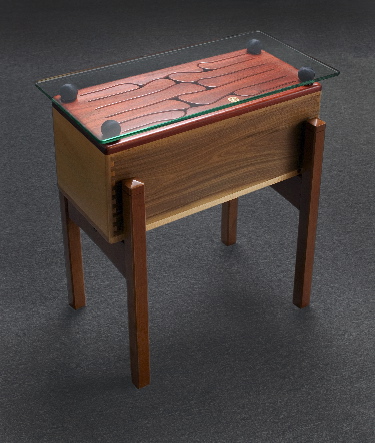 I stumbled back into Matt Collins Rhythm Craft Instruments again today. I thought that Matt had packed up when his prior URL went dead, but as it turns out, Matt is still alive and making wonderful creations.
 Mind you, I don't own any of Matt's toys, because most of them are rather pricey, but he is an incredible craftsman, and makes amazing things. His kalimbas are probably the best on the planet today. He also makes shakers, berimbau's, and slit drums (like the one shown at the right). Every piece is practically a museum piece. Wander around his website for awhile and you'll be truly amazed.
Sunday, April 02, 2006
AmerIndian 2192
 I just finished listening to the podiobook: AmerIndian 2192, written by J. Scott Garbay.
 AmerIndian 2192 is a science-fiction novel that explores the intriguing possibilities of Native Americans in mankind's star flung future. AmerIndian 2192 presents the story of two brothers, Wovoka and Keokuk, restoring the Native American people to a Homeland where their vibrant culture can thrive. Lodge ships, Cybershaman rituals and Tsimshian high technology are all elements in this action-oriented tale of interstellar politics and personal struggles.
I chose to listen to this podiobook first of all because of my love of science fiction, and second of all because of my love of Native American culture. This book, set in the future, has an interesting plot line and character development. I listened to new chapters each week during my weekly commute to the bay area and it made the commute pass quickly. The story had plenty of spaceships, political intrigue, cyber shamanism and cultural relevance. The story is read by J. Scott’s wife Leanne, and she does a great job with the reading. I could tell that she improved her skill as the story reading progressed.
Overall, this was an enjoyable podiobook. I would recommend it to anyone who enjoys science fiction and Native American culture. It is a one of a kind story, as far I am aware. You can down load the MP3 files to your computer and listen to them, you can burn a CD an listen that way, or your download it to your iPod or MP3 player.
Saturday, April 01, 2006
Native American Flute with built in digital recorder
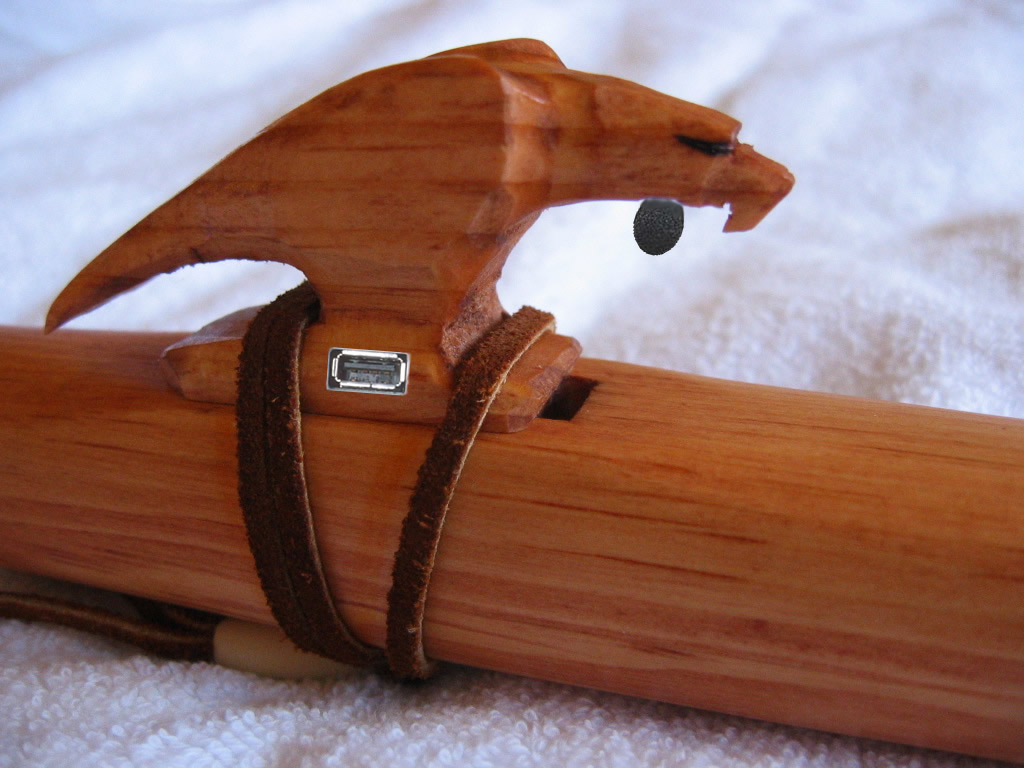 Sloof Lirpa Spirit Flutes has just announced the development of the first Native American Flute with a built in digital recorder!!
According to Billy Coyote Raven, the flutemaker, new advancements in the miniturization of chip sets has enabled the creation of a Native American Flute with a built in microphone and digital recorder. Coyote recently retired from 40 years working for NASA where he help produce miniturized components for the Space Shuttle. His love of the flute and experience as a NASA engineer have come together in this unique creation. I met Billy at a conference last fall, where we got to talking about this idea.
The miniture microphone is embedded in the totem of the flute, virtually invisible. Also hidden under the totem is a battery compartment which powers the recorder.
I hear that initially it's only available in a 64MB version, which will provide about a half hour of recording time. But the 96Khz samples are near CD quality, making your flute recording as simple as possible. Good enough to capture a few songs when the spirit hits you. A USB 2 port on the totem provides the ability to connect to a computer to download the songs in WAV format. Billy is sending me a prototype to test next week, I hope to bring it to a flute circle and share this unique creation. Billy hopes to go into production in the early summer, initially producing just individual totems which will fit any existing flute.
Subscribe to:
Posts (Atom)