Xavier will play throughout the day Saturday and have a special presentation Sunday, hope to see you there!!!Gathering this second year in the West side of San Jose @ the Gardner Community Center and Park.
Tentative Event Schedule:
Saturday, March 11
6 AM Sunrise Ceremony and Honoring of our Elders
8 AM Preparation of our Ceremonial Circle and Alter (Momoztli)
10 AM - 4 PM: Music, Song and Dance Ceremony including representatives from the following nations: Ohlone, Washoe, Zunis and Mexicas
12 noon: Begins In Toka Tokaitl "Siembra de Nombres" Mexica Naming Ceremony.
5 PM: Mexica Music Presentation by: Mixcoacalli (LA)
6PM: Live music by San Jose's own Lado Oriente (Cumbias) and Tecpot (Hip-hop)
Sunday, March 12
12 noon: Tianguiz/Market place opens up
1:30 PM: Live Performance by Xavier Quijas Yxayotl www.yxayotl.com
2:30 PM: All Nations Drum Group and Medicine Warrior Dancers from Oakland, CA
3:00 PM: Lawrey Bagey (World Class Navajo Hoop Dancer)
3:30 PM: Keynote Speaker Ocelocoatl (Mexico Tenochtitlan)
Mexica Tianguiz /Indigenous Arts & Crafts Market (Both Days):
Huey Tlahtocan (Chicago) Anahuac Designs (LA) Enrique Romero (Decoto) Primer Pueblo Libereria (San Jose) Maya Jade (LA) Indigenous Revolution (LA) Puro Chicanismo (Oakland) Cultura (San Jose) Corazon del Pueblo (Oakland) Pochteca Imports (LA) Inkas (Stockton) Apoyo Tarahumara (Watsonville) Insurgentes (Echo Park) Nash Tavewa (Orange County) Pochtecayotl (San Jose)
There will be Food for Sale, Raffles, Kids Activities and More.
Sponsors: This event is realized with the help and hard work of the following organizations: Indigenous Peoples Council, Native Voice TV, El Observador Publications, Resources for Family and Community, SEIU Local 715 Latino Caucus, Gardner Advisory Council and Calpulli Tonalehqueh
Come support this important historical gathering... Tlazo camati on behalf of Calpulli Tonalehequeh,
Yei Tochtli Mitlalpilli
408.576.7151:
Direct408.324.6215:
Cell408.570.4666:
E-fax www.pochtecayotl.com

Wednesday, March 08, 2006

Mary Youngblood announces "Dance with the Wind" release party
Mary Youngblood has just announced an album release party and concert in Sacramento, for her upcoming album: "Dance with the Wind". As of this posting, the East West website does not have the event posted on their calendar, but you can call and purchase tickets. It's not a huge site, so this will sell out!! Let's have a big NCFC showing to support Mary!
I had the chance to hear some of the songs from the new album during Mary's concert in Grass Valley last month. We're in for a treat, this is going to be another excellent album.
Sacramento East West Bookstore
Saturday, May 20, 2006
7-10 pm
$20
2216 Fair Oaks Blvd.
Fair Oaks, CA
95825
Phone: 916-920-3837
Monday, March 06, 2006
The Stellar's Electronically Tuned Rooster
 This is the humor posting of the month! I just got done reading a wonderful story, written by Erika Stewart on the Stellar Flute website. It's a story of human and chicken interaction, but I won't spoil the plot - you'll just have to read it yourself. Anyone who's ever tried to play a song for the animals in your lives will enjoy this one.
While you are there, make sure that you check out the wonderful and unique flutes made by Tom and Erika Stewart.
Friday, March 03, 2006
NAF FAQ: What is a Flute Circle?
 I am often asked the question: What is a Native American Flute circle?
Short answer: it's a gathering of people who play the Native American Flute for fun, personal enrichment and fellowship. It's nothing more complicated than that.
It's not about being "Native American", although most folks who attend a flute circle cherish the rich cultural background of the Native American Nations. It's not about being "New Age", although some folks find a stong identity in New Age philosophy. It is about the music, and everyone in attendence wants to hear Native American flute music or improve their skills with the Native American flute.
Each flute circle, and each event for that matter, has it's own personality. I've been to flute circle events where it was nonstop spontaneous playing for three hours, and I've been to other events where all we did was share stories and talk about flutes and flutemakers for three hours. I've been to events where everyone was a beginner and other events where everyone was a seasoned musician of some sort or another. I've been to other flute circles where I never touched a flute and played percussion all afternoon while everyone else jammed along on the flute or other instruments.
Regardless, the most important thing in my opinion is to have fun and be spontaneous at any flute circle event. I love discovering new melodies when playing a duet with somebody who I have never jammed with before. I equally love seeing somebody "light up" with excitement when they learn a new technique or find some new source of inspiration which they've never had before.
I've made some wonderful lifelong friends through my experiences with the Northern California Flute circle. I hope that you find your experience with your local flute circle/clan to be a similar experience. Just remember that flute circles are a grass roots organization. The flute circle is nothing more and nothing less than what everyone together contributes to the organization. Whether you are leading an event, hosting an event or attending an event, everyone contributes to the experience. I encourage you to take the time to welcome new faces and include everyone in the experience. Invite somebody new to a circle. We always have a meal as part of the flute circle, because nothing builds a community like sharing a meal together.
If you would like to find a flute circle in your area, you can either look online at the NCFC website (for Northern California and surrounding areas) or the INAFA website for a listing of worldwide flute circles.
Thursday, March 02, 2006
African drum maker infected with Anthrax
Some of you may have heard the news or story about an African drum maker who became infected with naturally occuring b. anthracis, while working with untreated animal skins. Here's an exerpt from an email I received on one of the email groups highlighting this story:
"Subject: Update on Vado + Regarding Anthrax: Specific Facts for Drum-makers, Drummers, & Dancers
hi all,I've been requested to get this out to everyone by the people closest to Vado, the West African dancer from the East coast who came down with anthrax last week. This is an 8 page pdf, written by Krista Retto, the daughter of a registered nurse and a close personal friend of Vado &Lisa's, who is helping them get through this crisis. I have already posted this information to the Djembe-L files section, you can click here to see the pdf I have also put the entire text, with photos, on The African Music Encyclopedia, as a public service: http://africanmusic.org/anthrax_info.html
Feel free to download the pdf and distribute to anyone who might be interested or whom might really need this information. One request from the friends and family - please try to restrain yourselves from emailing them for updates, they are overwhelmed with the hundreds of emails they have already received. I have suggested they add a guestbook totheir site http://www.kotchegna.com/ for everyone's well-wishes, please try to be patient and give them some time to get this done. If you would like to help:f or the friends and community who love Vado, Loving friends of Vado's have set up a recovery donation fund for him.
If you would like to contribute, send a check or money order to:
Diomande Trust
c/o A. King105 E. 15th Street #48
New York, NY 10003
NAF Playing Tip #10 Exercise: Play & Repeat with emphasis
Here's a good exercise to engage your creative muse. This exercise is designed to iteratively modify a given phrase or group of notes, creating a slightly different melody simply by emphasizing a different note or grouping of notes each time. I have used this technique many times to perfect the phrasing in a song.
Play a short phrase, and then repeat it but emphasize a different note. You can emphasize a note using any of the ornamentation techniques that you have learned, or by simply playing the note louder, softer, longer or shorter. This exercise is a great precursor to constructing a song, and it is a great skill to build upon because it trains your brain to think about a phrase in different ways. A lot of time this kind of experimentation may actually give you a better sounding phrase than you originally started with, or it may completely change your mood.

This Playing Tip is licensed under a Creative Commons Attribution-NonCommercial-ShareAlike 2.5 License.
Play a short phrase, and then repeat it but emphasize a different note. You can emphasize a note using any of the ornamentation techniques that you have learned, or by simply playing the note louder, softer, longer or shorter. This exercise is a great precursor to constructing a song, and it is a great skill to build upon because it trains your brain to think about a phrase in different ways. A lot of time this kind of experimentation may actually give you a better sounding phrase than you originally started with, or it may completely change your mood.
This Playing Tip is licensed under a Creative Commons Attribution-NonCommercial-ShareAlike 2.5 License.
Wednesday, March 01, 2006
High Quality Djembes

I had a friend ask me the other day where to purchase a good Djembe. There are ton's of auctions for Djembe's on Ebay, but I don't recommend this as a source since the quality of Djembe's can be so varied. There are very few sources from which I will purchase a drum site unseen. However, of those sources here are my recommendations:
Drumskull Drums (in Santa Cruz, CA), which also has a great listing of classes/workshops in Northern California.
Mountain Rhythm (in Canada), which feature a unique/patented drum tuning mechanism. Note that you can find Mountain Rhythm drums for sale on Ebay, probably a good choice. They don't make any bad drums.
If you have the opportunity to travel to Santa Cruz, you can also visit Rhythm Fusion (downtown Santa Cruz) and play their inventory of drums (and other wonderful world instruments). This where I bought my first Djembe. However, if you're going to make the drive, make sure that you give the guys at Drumskull a call as well and stop by their place (it's not really a store...).
 Finally, if you live on the peninsula, I recommend contacting Richard Saasta of Rhythmic Intentions. I met Richard through the Peninsula Pulse Drum Circle and he makes wonderful drums. I also had him make a custom Djembe stand for me (pictured in the image to the left), so that I can play standing up at the drum circle. Richard takes the a basic shell (which he buys wholesale from Drumskulls) and then finishes and carves the shell before skinning it. He has a nice inventory of drums available and is happy to let you "try out" a drum at the monthly Peninsula Pulse drum circle before you purchase a drum. (Tell him Mike sent you...) :-)
Tuesday, February 28, 2006
Open source computer recording software

If you are looking for free, open source recording software which runs on both the PC and MAC, then I highly recommend the Audacity application, which is available for download from Source Forge.
With the Audacity application, you can record through a microphone on your PC's sound card and edit your songs on your computer. Once you have recorded your song, you can save it in a variety of formats, including MP3's. You can also edit your song, to include reverb, delay, and other effects. For free software, you really can't beat this fully featured, open source application. If you want to save your money for flutes, then this is the best deal on the planet for starting your home studio.
Saturday, February 25, 2006
Surprise Gift pack
I arrived home from vacation this week to find an nice fat package in my mail box! It was a gift package of CD's from Gary Stroutsos. I've been chatting with Gary via email the last month about the upcoming INAFA conference, where Gary will be performing on stage with Will Clipman. I also recently downloaded Gary's latest CD project with David Lanz:: Spirit Romance (see the "what's in my CD player link on the left nav bar of the blog). I had asked Gary about the flutes that he played on Spirit Romance, since one disadvantage to downloading songs on iTunes is that you don't get the liner notes. In response, Gary sent me a copy of the Spirit Romance CD (look for an upcoming CD review in a future blog posting) along with copy of the excellent Makoche Masters, a copy of Quiet Fire - Zen Moods for the Spa experience (featuring Gary, Will Clipman and William Eaton), a copy of Oru:the natural order and a copy of Inside Canyon de Chelly (featuring Gary Stroutsos and Paul Thompson). I wanted to thank Gary publically and encourage anyone who hasn't discovered Gary's music to give it a spin, he's a great flutist, in my opinion.
WOW! I've had fun this week, working and listening to all of this great flute music. Gary and I go back to a master class that Gary presented in Calistoga 5 years ago. Bob Bellus brought Gary down from Seattle for an "all NCFC" performance and workshop. I was fortunate to attend. Now I'd like to do the same: bring Gary back to No Cal for a master class and a small schedule of performances sometime this year. Maybe we can even get Gary to bring David Lanz with him. Let me know your thoughts on this idea, and I'll see what we can do to make it happen.
WOW! I've had fun this week, working and listening to all of this great flute music. Gary and I go back to a master class that Gary presented in Calistoga 5 years ago. Bob Bellus brought Gary down from Seattle for an "all NCFC" performance and workshop. I was fortunate to attend. Now I'd like to do the same: bring Gary back to No Cal for a master class and a small schedule of performances sometime this year. Maybe we can even get Gary to bring David Lanz with him. Let me know your thoughts on this idea, and I'll see what we can do to make it happen.
Friday, February 24, 2006
New professional palm-size recorder from M-Audio
 My March edition of Electronic Musician arrived this week, and as I was browsing it I found an ad for an exciting new piece of palm-sized technology. The M-Audio MicroTrack 24/96, looks like a very interesting portable digital recorder with some great features. It's a bit pricey at $499 (list), but for a portable digital recorder, this should give you a professional sounding recording and the ability to easily transfer your recordings to the computer. I love M-Audio technology, and currently own an M-Audio Delta 44 soundcard. Here are a couple of reviews for the Microtrack 24/96:
O-Reilly Digital Media
Gizmondo
Features include:
- 2-channel WAV and MP3 recording and playback for pro recording, meetings, training, education and worship
- Battery-operated; storage via convenient CompactFlash or microdrives
- Immediate drag-and-drop file transfer to PC and Mac via USB 2.0 mini-connector
- Balanced 1/4” TRS inputs with line inputs and phantom-powered mic preamps
- S/PDIF digital input; RCA and 1/8” headphone monitoring outputs
- Comes with a stereo microphone
Thursday, February 23, 2006
NAF Playing Tip #9: Alternative Fingerings
The basic pentatonic scale has been posted many times, on many websites. My favorite website for listing scales and explaining the various fingerings is Flute Tree.
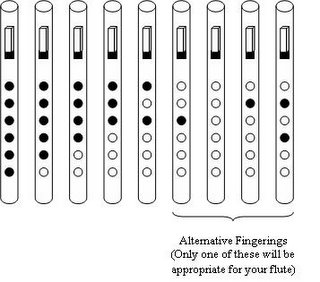
There are several alternative fingerings for the octave note on the moderm Native American flute. These alternatives are a result of divergent flute making/tuning practices, most of which have a historical origin. Neither is better or worse than the other, however it is important to ask a flutemaker how he/she designed a flute before you purchase a flute.
There are several flutemakers who use an alternative fingering for the flute. The most notable of this style of flutemaker include Ken Light (Amon Olorin Flutes), Scott Loomis (Wind’s Song Flutes) and Butch Hall (Butch Hall Flutes). The notable thing about this variable fingeringis that these flutemakers strive to create flutes with equally spaced finger holes that are all the same diameter. As a result of the physics of making flutes in this style, an alternative fingering is required. These flutes will always be six-hole flutes. There are three additional variations for the Position 6 note shown below:
This Playing Tip is licensed under a Creative Commons Attribution-NonCommercial-ShareAlike 2.5 License.
There are several alternative fingerings for the octave note on the moderm Native American flute. These alternatives are a result of divergent flute making/tuning practices, most of which have a historical origin. Neither is better or worse than the other, however it is important to ask a flutemaker how he/she designed a flute before you purchase a flute.
There are several flutemakers who use an alternative fingering for the flute. The most notable of this style of flutemaker include Ken Light (Amon Olorin Flutes), Scott Loomis (Wind’s Song Flutes) and Butch Hall (Butch Hall Flutes). The notable thing about this variable fingeringis that these flutemakers strive to create flutes with equally spaced finger holes that are all the same diameter. As a result of the physics of making flutes in this style, an alternative fingering is required. These flutes will always be six-hole flutes. There are three additional variations for the Position 6 note shown below:
This Playing Tip is licensed under a Creative Commons Attribution-NonCommercial-ShareAlike 2.5 License.
Wednesday, February 22, 2006
2006 NCFC Member Survey is now online!
The 2006 NCFC Member survey is now online. You can take the survey here.
Note that if you submitted your survey by mailing in the paper version which came with the Winter Voice of the Circle newsletter, please don't retake the electronic version (no stuffing the ballot boxes...). The electronic version should only take about 5-10 minutes to complete. The survey link will only be valid for 10 days so it will close on March 3rd.
Note: Zoomerang is an excellent free survey service. It's a great tool for flute circles and other organizations to use to setup online surveys. It took me about 30 minutes to create the electronic version of the survey by copying and pasting questions from the word document in which the original survey was printed. While the free service does have some limitations, such as only lasting 10 days, there is a 'professional' version of the service with significant features.
Winter break 2006
I am back online after a short winter break. This year we went to Lake Tahoe for a couple days of sledding and skiing (along with everyone else from the bay area it seemed). The snow was awesome (15+ inches of fresh powder), but the crowds and lift lines weren't. Regardless, the kids had a great time, so that's al that matters. I am back online now.
Tuesday, February 14, 2006
Happy Valentines Day!!
I hope that everyone of you get the opportunity to play a song for that special someone in your life today, remember that the flute was used for courting in some tribes. So continue the tradition or make some new traditions of your own...
If you don't have a special someone in your life at the moment, then I encourage you to play a song for all of us two-leggeds, that we may find greater love for each other as individuals and for our mother earth.
Here's the word of the day: spoony - foolishly or sentimentally in love.
If you don't have a special someone in your life at the moment, then I encourage you to play a song for all of us two-leggeds, that we may find greater love for each other as individuals and for our mother earth.
Here's the word of the day: spoony - foolishly or sentimentally in love.
Monday, February 13, 2006
NCFC Winter Newsletter is in the mail
The Winter 2006 NCFC newsletter: Voice of the Circle, is now in the mail to NCFC members. The electronic version of the newsletter will be posted soon on the NCFC website.
Note that this mailing includes a 2006 member survey, members have the option to complete either the paper version of the survey or an electronic version of the survey, which will open online on 2/15 (stayed tuned, I'll post a blog entry with the link, once it opens). In the survey are questions about your thoughts for NCFC events this year: the INAFA Convention, the annual NCFC Camping trip, concerts, workshops, etc.
I am looking for an NCFC member who is a graphic artist (with the appropriate software...) to volunteer to help with design activities this year. We need to create a new T-Shirt design and other mechandise elements for the INAFA Convention later this year. If you are interested, please drop me a line.
NCFC members: note that we are redesigning the NCFC Membership badges/cards and we will be sending new membership cards to everyone within the next month or two. Make sure that your membership is current to receive a new membership badge/card.
100th Post!
Wow, I just realized that I surpassed the 100th blog milestone this weekend!! Sometimes, it's a struggle to post something interesting everyday, but I hope that you enjoy this stream of information. I encourage any of you to consider creating your own blog. Blogger.com makes it so simple to setup and manage your blog, that anyone can do it. You don't need any HTML skills or anything else technical to create a blog. If you can use your email program, you can create a blog. If you are a flute circle leader, this is the perfect tool for communicating with your flute circle members, in lieu of a website.
Saturday, February 11, 2006
New Flute Circle starting in Reno NV
 Jeff Lock is starting a new flute circle in Reno Nevada. Their first event is next Saturday, February 18th, 12:30 to 2 (ish). Jeff says that beginners and experienced players alike are encouraged to join. Bring your flutes, drums, rattles to the event to make some music. Jeff would love to have a few NCFC members joint them for the inaugural event.
For directions, contact Jeff at: lockoutdoors AT aol DOT com
By the way, did you know that Reno is the only city to have a downtown whitewater park? Very cool...
Friday, February 10, 2006
2006 INAFA Convention Workshop
Today, I was honored to be selected to present a workshop at the 2006 INAFA Convention. The working title of my workshop is: "Starting, Marketing and Growing your Flute Circle" and the focus of the workshop will be how to start and grow a flute circle along with lots of ideas for interesting flute circle activities.
I have been fortunate through this blog and the various native american flute listserv's to meet people from all over the world and to share idea's about creating and managing a flute circle. I have also been fortunate to develop friendships with other flute circle leaders including Dan Ricketts, Lynn Peck, Frankie Sierra, Bill Timothy, RuthiE Neilan and Guillarmo Martinez. Of course, I count the experience which I gained first hand from Bob Bellus as key in setting me on my path to lead the Nothern California Flute Circle. Bob Bellus, in my opinion, was really the first true flute circle entrepreneur. Bob demostrated to me what it meant to be an advocate for the growth of the Native American Flute experience. Without Bob's vision and core guidance, the NCFC wouldn't be the organization it is today.
So if you have started, or are thinking about starting a local flute circle, I'd be honored if you would send me your input or questions about the day to day and month to month issues of starting and maintaining your flute circle. Together, we can use this information to pull together a very informative workshop at INAFA.
You can reach me at: mike DOT oitzman AT gmail DOT com
Thursday, February 09, 2006
NAF Playing Tip #8: Playing with a guitar
It’s important to realize that when playing with a guitar, the guitar must tune to the flute that you are playing, since it is impossible to “tune” a Native American Flute.
(What’s the old saying? You can tune a piano but you can’t tuna fish- or a Native American Flute for that matter)
Guitar Minor Pentatonic Scale
There is a minor pentatonic scale that exists on the guitar. It can be fun to play along with a guitarist who knows how to play the minor pentatonic scale. The same rules apply as if you are playing a duet with another flutist. Experiment with 'echoing' with the guitar player, where one person plays a short phrase and the other follows, or echos the phrase.
 Figure 1 - The Minor Pentatonic Scale for Guitar
Note to guitarist: For ease of playing, a capo could be applied on the guitar at the appropriate fret that corresponds to the key of the flute being played. The root note of the pentatonic scale correlates to the lowest note on the bass string (string 6). In Figure 1, this would be compatible with a flute in the key of E. For practical purposes this means playing flute between E and A.
This Playing Tip is licensed under a Creative Commons Attribution-NonCommercial-ShareAlike 2.5 License.
The Renaissance of the Native American Flute 2006
Ken Light sent along the following invitation. Since I first heard zbout the RNAF 10 years ago when I started my path with the flute, I have wanted to attend. There are many annual flute gatherings happening throughout the year and throughout the US, but this is the one which spawned them all.
"The Renaissance of the Native American Flute - with R.Carlos Nakai, Ken Light, and John Sarantos June 17-24, 2006 Feathered Pipe Ranch Helena, Montana - 15 Year Reunion, 1992-2006
Join us this summer for our 15th Annual Renaissance of the Native American Flute Workshop and Returnee's Reunion. This week-long flute educational experience is well-known as North America's premier native flute event. Nakai and Light, in addition to their world-class work in flutemaking and performance, combine over 60 years experience as professional educators. Since 1992, these two former classroom teachers have developed and refined a curriculum as the foundation for what has become known as the finest nA flute educational event on the planet.In conjunction with reunion activities bringing together an awesome collection of returning talent, Light and Nakai will be teaching their intensive six-day curriculum. Come prepared to work, but ready for alot of fun! Classes in history and culture, construction and maintenance, basic playing techniques and traditional ornamentations, developing your music in both improvisation and composition, plus classes in designing performances and presentations, working with students, advanced playing secrets, special evening presentations, and much, much more. In addition to the large group lectures and presentations, beginners will find a special group of classes designed just for them. Our third teacher, John Sarantos, a ten-year veteran of the event, will assist Ken and R.C. as special teacher and liason for our newer flute players. You will learn to play the flute and you will have a lot of fun! Plus an opportunity to hang out with the most awesome collection of nA flute energy on the planet. What could be better?
Nakai's advanced mini-course in performance, digital and analog sound systems and more is also offered for qualified flutists and returning workshop participants. An initial interview and demonstration TABlature sight-reading proficiency audition is required for this advanced performance-oriented portion of the workshop. Regardless of your current level of experience, there will always be the path ahead of you on your own flute journey. At RNAF our main goal is to assist you in developing your relationship with the native American flute and to better express yourself with its music. Come!
For registration information, go to website listed below and click on "Workshops".
Thanks, kl.
Amon Olorin Flutes Contemporary Native American Flutes by Ken Light
492 Lemlama Lane
Arlee, MT 59821
406-726-3353 phone and FAX
"Everybody needs a flute!"
Please visit my website: www.aoflutes.com
Tuesday, February 07, 2006
Clearance Sale on John Vames book
 I am offering the excellent beginners book: "Understanding the Gift" by John Vames at a clearance sale price: $17.50+tax & shipping. This book is normally $25 and includes a CD. For those of you in the Bay Area, you can save shipping if you want to pick up a copy from me when I am in town during the week.
John Vames, lives in Arizona and has been teaching longer than I have. I bought flutes by Jonah Thompson for my first class of students from John's wife Sherry, in an ebay auction. That was 6 years ago. John takes a very practical approach in this book, teaching basic music theory on the Native American Flute. It is highly recommended. To order, drop me an email: mike DOT oitzman AT gmail DOT com
Monday, February 06, 2006
Xavier Quijas Yxayotl in Concert on March 12
 Mark your calendars now for a rare opportunity to see Xavier Quijas Yxayotl performing live in the Bay Area at the Mexica New Year Ceremony taking place on March 11 - 12 2006. For those who haven't seen Xavier or heard about his amazing "fire flute" playing on stage, this will be a real treat.
Below is the Tentative Schedule of Event:
Saturday, March 11
6 AM Sunrise Ceremony and Honoring of our Elders
8 AM Preparation of our Ceremonial Circle
10 AM - 4 PM: Music and Dance Ceremony
Including representatives from the following nations: Ohlone, Washoe, Zunis and Mexicas
12 noon: Begins In Toka Tokaitl "Siembra de Nombres" Mexica Naming Ceremony.
5 PM: Live Entertainment from San Jose: Lado Oriente (Cumbias) and Tecpot (Hip-hop)
Sunday, March 12
12 noon: Tianguiz Market place opens up
1:30 PM: Live Performance by Xavier Quijas Yxayotl
2:30 PM: All Nations Drum Group and Medicine Warrior Dancers from Oakland, CA
:00 PM: Lawrey Bagey (World Class Navaho Hoop Dancer)
3:30 PM: Keynote Speaker Ocelocoatl (Mexico Tenochtitlan)
Other Activities: There will be a traditional Indigenous Market Place all weekend, Food will be available for Sale, Raffles, Kids Activities and More.
Sponsors: This event is realized with the help and hard work of the following organizations: Indigenous Peoples Council, Native Voice TV, El Observador Publications, Resources for Family and Community, SEIU Local 715 Latino Caucus, Gardner Advisory Council and Calpulli Tonalehqueh
For more informaion, contact: Calpulli Tonalehequeh, Yei Tochtlin Mitlalpilli 408.576.7151: Direct 408.324.6215: Cell 408.570.4666: email: mitlalpilli AT hotmail DOT com
Sunday, February 05, 2006
News from Mary Youngblood's Concert
Wow, what an evening we had last night. Mary Youngblood and a few of her friends put on an awesome show at the Grass Valley Center for the Arts. In typical Mary style, she had an intimate connection with the audience throughout the whole evening. I'll tell you what, I wouldn't want to see Mary in any larger venue, it's so special be that close to her during the show. I first saw Mary in concert at East West Bookstore in Mountain View. It was right after her first album and at that show there was probably 20 people in the audience.
I'll talk more about Mary's flute playing in a moment, but one of the things that I personally love about Mary's stage presence are the stories which she tells before each song. Her storytelling gives you that extra insight into why each song is important to her, and makes it that more special when you hear it. My favorite story for the evening was the one in which Mary recounted the birth of her first granddaughter, born last summer on Mary's birthday. Which by the way also happens to be the birthday of Mary's daughter-in-law, three generations born on the same day!
First of all it was a sold out show, which is a great tribute to Mary's talent. We arrived a hour before the show, to setup the NCFC table and to get a good seat. We were fortunate to get a seat in the second row, right in front of Mary's mic.
In the first set, Mary started out playing many of the familar and favorite tunes from her first couple albums. Then she brought out the band to join her in some of the songs. She had a guitarist, a percussionist and a guy on blues harp. Unfortunately I can't remember all of the names of the other performers, but they all played wonderfully. Mary had provided a bag of rattles for the audience to use in the audience participation part of the evening. We all joined her and the band in 4 or 5 tunes throughout the evening.
The best part of the evening was that we were fortunate to catch a preview of some of the new songs on her new album which is coming out in the spring. I can't wait to hear the whole album when it hits the streets in April. Mary sang for us on several of the songs, which was a real treat.
She also played several songs, including a great little blues tune, on a tiny little root flute.
The NCFC's own Francesa Reitano, from the Capitol Clan, made an appearance on stage with Mary. The two of them played a wonderful duet, "dancing with the flutes" as Mary highlighted the experience for folks in the audience.
The biggest surprise of the evening came from Sharon Downer, another NCFC member, who gifted Mary with a special guitar from Sharon's late husband. Sharon read a touching poem and the punchline was that the guitar was the "gift that keeps on giving". Mary was really touched, as were most of us in the audience (I know that I was). Sharon was joined on stage by three of her grandchildren for the moment.
Working the mic as MC for the evening was Skip Allen Smith from KVMR. Skip hosts the show "Dreamwalk" on Thursdays at 10 AM. You can listen to Dreamwalk streaming over the internet if you don't live in the Grass Valley area. Skip told me after the show that Mary donated a flute to the KVMR pledge drive last week, and it generated $1000 in raffle for the show.
Wednesday, February 01, 2006
Tour of Notre Dame de Namur University
 On Friday, January 27th, Bob DeMattei, Dan Ricketts and myself had a site visit of Notre Dame de Namur university. This is the site for the 2006 INAFA Conference. We were there to see all of the facilities which will be used for the INAFA Conference.
NDNU is a small catholic college nestled in the woods of Belmont. It founded in 1851 by the Sisters of Notre Dame de Namur in San Jose and moved to Belmont, California, in 1923.
Personally, I am very excited about the event being held here in Nothern California. The NDNU campus is small campus and after seeing the arrangement of the buildings, housing and cafeteria I am even more excited about the INAFA conference. The great thing is that everything is centrally located. No building is more than a 10 minute walk from the other, which means that there will be plenty of opportunity to met and get to know people during the event. There are also plenty of 'performance spaces' around the campus. From small niches to stands of trees, there will be many opportunities for small group interactions or informal jams. I am excited that NDNU will offer this environment to help you stretch your playing ability and interact with others. The on campus housing also looks like it will foster interaction. The INAFA team is still finalizing the details on the housing situation, but I can tell you that you will be comfortable on campus. There is a small shopping center with a Walgreens drug store and other stores a short 1 mile walk from campus, so anyone who is planning to come shouldn't need a car, unless you want to do some off campus sightseeing in the bay area.
I'll post more details and some pictures of the campus in a later post.
Monday, January 30, 2006
Free Online Graph Paper Generator
I discovered this cool website which generates a variety of lined paper. It includes graph paper, paper for creating Celtic knots, caligraphy paper, elementary school penmenship paper and also
music staff. All of the files are available or generated as PDF's. Very cool.
music staff. All of the files are available or generated as PDF's. Very cool.
Monday, January 23, 2006
Mary Youngblood in Concert Feb 4th
 Mary Youngblood will be in concert in my neck of the woods on Saturday, February 4, at The Center for the Arts in Grass Valley at 8:00PM, tickets are $20. Don't forget to bring percussion instruments to jam along with Mary, whe always includes some audience participation during her concerts.
This should be a wonderful evening. The Center for the Arts is nice medium sized venue and every seat in the house is a good one. Check back, I'll try to coordinate a get together for coffee and dessert for NCFC members after the show somewhere in town!!
Sunday, January 22, 2006
American Indian DNA project
I stumbled into an interesting topic, however I am not sure of the validity of this. So while I present it here, I am not recommending this project one way or another. If any one out there knows more about this project, add a comment or drop me line.
The American Indian DNA Project is a project dedicated to proving the heritage of Native American or American Indian through DNA testing. It uses genetic markers found through recent genetic research conducted on full-blooded native populations in North, Central and South America. They are offering free at home DNA testing kits.
The American Indian DNA Project is a project dedicated to proving the heritage of Native American or American Indian through DNA testing. It uses genetic markers found through recent genetic research conducted on full-blooded native populations in North, Central and South America. They are offering free at home DNA testing kits.
Thursday, January 19, 2006
NAF Playing Tip #7: Flutter Tonguing
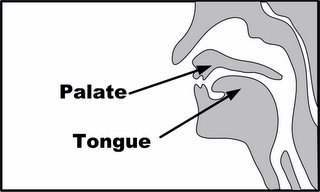
Flutter Tonguing is another tonguing technique and is the flute playing equivalent to “Rolling your R’s” in Spanish class. What’s happens when you produce the flutter tongue is that your tongue strikes the palate of your mouth repeatedly as the air rushes past it. Place your tongue against your palate, directly behind your top teeth. Now, slightly relax the tip of your tongue while keeping pressure with the back part of your tongue. Blow. The relaxed part of your tongue should flap up and down against your palate, sounding something like the engine on a motorboat.
 NOTE: I have discovered that this technique is very difficult or even impossible for some adults to learn. The key being that if you didn’t learn to “roll your R’s” or make the “motorboat” sound with your tongue early in life, it may not be physiologically possible for you to learn this technique as an adult. Anecdotally, somewhere around 20% of my students can’t do this.
This Playing Tip is licensed under a Creative Commons Attribution-NonCommercial-ShareAlike 2.5 License.
 NOTE: I have discovered that this technique is very difficult or even impossible for some adults to learn. The key being that if you didn’t learn to “roll your R’s” or make the “motorboat” sound with your tongue early in life, it may not be physiologically possible for you to learn this technique as an adult. Anecdotally, somewhere around 20% of my students can’t do this.
This Playing Tip is licensed under a Creative Commons Attribution-NonCommercial-ShareAlike 2.5 License.
Tuesday, January 17, 2006
Yahoo Groups Privacy Policy Warning...
Got this from an email on on of the NAF listservs:
If you belong to any yahoo Groups this is important...
"Yahoo is now using something called "Web Beacons" to track Yahoo Group users around the net and see what you're doing and where you are going --similar to cookies. Yahoo is recording every website and every groupyou visit.
Take a look at their updated privacy statement:http://privacy.yahoo.com/privacy
About half-way down the page, in the section on cookies, you will see a link that says web beacons. Click on the phrase web beacons. That will bring you to a paragraph entitled "Outside the Yahoo Network."
In this section you'll see a little "click here to opt out" link that will let you "opt-out" of their new method of snooping.
Once you have clicked that link, you are exempted. Notice the "Success" message on the top of the next page. Be careful because on that page there is a "Cancel Opt-out" button that, if clicked, will *undo** the opt-out. Feel free to forward this to other groups.
Also, please note that the opt-out is not user-specific - so you will have to opt-out on each computer and/or browser you use.
Private Flute lessons in the Bay Area and Grass Valley area
I have started teaching private lessons again and I have several new students. I am typically in the bay area on Tue/Wed/Thur evenings.
I am also available for lessons in the Grass Valley / Nevada City area on the weekends.
If you are interested in scheduling a class, please let me know.
Email: oitz @ naflute DOT com
I am also available for lessons in the Grass Valley / Nevada City area on the weekends.
If you are interested in scheduling a class, please let me know.
Email: oitz @ naflute DOT com
Monday, January 16, 2006
Accessing Rhythmic Understanding : A TaKeTiNa Rhythm Workshop
 Friday night January 20, 7–10pm;
Saturday & Sunday January 21 & 22, 10am–6pm
Place: Hidden Villa Visitors’ Center, 26870 Moody Road, Los Altos, CA
Workshop leader: Zorina Wolf, advanced TaKeTiNa teacher with Karen Jandorf on surdo.
There is a connection between understanding rhythm and increasing intuitive awareness. Both invite you into a deeply relaxing, non-linear world--inner spaciousness.
The TaKeTiNa process, developed by Reinhard Flatischler, invites us to explore and experience rhythm not only as it relates to music, but to every part of our lives.
In this TaKeTiNa workshop, we use our bodies—through stepping, clapping, and vocalization—to find a way into rhythm, joy, and intuitive learning.
We stand together in a circle and at the same time are on our own individual journey.
Sense the support of a “container” while you learn at your own atural pace.
Relax while accessing your rhythmic understanding and curiosity!
No prior instruction or musical training is necessary.
For directions,
Fee: $185* in advance; $250 day of.
For information call Village Heartbeat at 650-493-8046
EMAIL: info AT villageheartbeat DOT com
Wear comfortable clothes. You may want to bring water and a blanketor yoga mat for lying on the floor.
Sunday, January 15, 2006
INAFA Conference 2006, Call for Presentations

If you are considering presenting a lecture or a performance at the 2006 INAFA Conference in Northern California (hosted by the Northern California Flute Circle), then you need to get your requests into Kathleen Joyce soon. The INAFA website lists the performers and lecturers who have already been accepted.
You can send your proposal to:
INAFA Convention
3351 Mintonville Point Drive
Suffolk, VA 23435
You can email Kathleen at: inafa AT aol DOT com
Saturday, January 14, 2006
Gaden Monks return to Grass Valley
 The Gaden Monks will be in Grass Valley from Jan 15th - Jan 29th. This is sponsored by the Sierra Friends of Tibet.
The complete schedule is online. Most of the events take place at St. Josephs Cultural Center (where my Taiko group: Grass Valley Taiko just happens to have our dojo). This is a rare opportunity, it's not clear when/if the monks will be in our area again.
I am looking forward to viewing the Sand Mandala which will be open for viewing daily 10 AM - 4 PM starting on Sunday 1/15. On Friday 1/27, 7 PM there will be an explaination of the Sand Mandala.
Friday, January 13, 2006
Exercise: Basic Tonguing
Following yesterday's introduction to tonguing, here are a few exercises to work on improving your technique.
Put the flute to your mouth. Cover the top three notes of the flute, and blow a long steady note. Next, try saying “Tu” into the flute. Experiment with short and long notes: Say “Tu”. Next try a long one: “Tuuuuuuuuu”. Blow a note without tonguing - can you hear the difference in the attack? Practice the scale with the basic tonguing technique, until you can achieve it consistently on each note on the flute.
Double-Tonguing
Try a basic scale while double-tonguing the beginning of each note.
Triple-Tonguing
Try the basic scale will triple-tonguing the beginning of each note.
This work is licensed under a Creative Commons Attribution-NonCommercial-ShareAlike 2.5 License.
Thursday, January 12, 2006
Wild and Scenic Environment Film Festival starts tomorrow
In Grass Valley / Nevada City...
From the Wild and Scenic website:
"Join us for another fabulous weekend at the largest environmental film festival on the West Coast. The Wild and Scenic Environmental Film Festival sits apart from the hundreds of festivals around the world by leaving you feeling INSPIRED and MOTIVATED to go out and make a difference in your community and the world.
It’s a festival for activists by activists. The event is organized and hosted by the South Yuba River Citizens League. For over 20 years this grassroots environmental organization has been bringing the community together around the protection of the Yuba Watershed.
At the festival, you’ll LEARN new ideas from a selection of inspiring environmental films with hardhitting topics including bioengineering, water issues, wilderness preservation, citizen activism, and more. You’ll EXPERIENCE the adrenalin of kayaking the wildest rivers, climbing the highest peaks, and trekking across the globe with adventure films around the world. You’ll EXPLORE the issues and movements with leading environmental activists and professionals, filmmakers, and celebrities. And you’ll CELEBRATE the natural and wild world with 5+ venues of films and workshops, children's Saturday morning cartoons, art shows, wine tastings VIP parties, and a champagne breakfast and awards ceremony.
All this and more at the largest (and most unique!) film festival of its kind on the West Coast and in one of the most charming towns in the Sierra Nevada, NEVADA CITY, California.
NAF Playing Tip #6: Tonguing
The first technique to control the attack of the note is called tonguing, because you will use your tongue to interfere with and control the air going through your mouth and into the flute. There are a variety of ways to use your tongue to control the airflow through your mouth, and this is one of the most basic ornamentation techniques. Experimentation is best teacher, so find an isolated spot to practice this technique.
To visualize how your tongue controls the airflow through your mouth as you speak, say the words: “Tu” or “Du” or “Ku”. Put you hand in front of your mouth, do you feel the air stopping briefly and then continuing as you say these words? Now say the word: “Tu-Tu” or “Tu-Tu-Tu”. Continue by trying to say “Tu” into your hand repeatedly as many times as you can in one breath.
NOTE: The most difficult note to blow with the tonguing technique is the lowest note on the flute (position 1, the fundamental note). This is because the fundamental note is most sensitive to overblowing (see Overblowing below). It is recommended that you initially try this technique on one of the notes higher on the flute (e.g. position4 with only the top three holes covered).
Controlling the Attack: A Soft Attack and a Hard Attack
The key to controlling the attack is in understanding what happens at the start of the abrupt airflow stoppage by your tongue while saying “Tu” or “Du”. The word “Du” is an example of a softer attack, while the word “Tu” is an example of a harder attack. You can verify this by saying “Du” alternatively with “Tu” into your hand held in front of your mouth. Try it into your flute. Do you hear the difference between “Tu” and “Du”?
Double-Tonguing
Double-Tonguing is simply a technique where you quickly say “Tu-Tu”, “Du-Du”, or “Tu-Du” into your flute. In reality this produces a quick succession of two notes. Don’t forget that you can sustain the second note for a longer period of time.
Triple-Tonguing
Triple-Tonguing extends the idea of several quick notes, and is performed by saying “Tu-Tu-Tu”, “Du-Du-Du” or “Tu-Ku-Du” into the flute.
This Playing Tip is licensed under a Creative Commons Attribution-NonCommercial-ShareAlike 2.5 License.
Wednesday, January 11, 2006
Gentle Thunder Trio in Concert 1/27 & 1/29
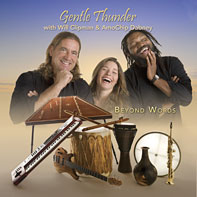 The Gentle Thunder trio featuring Gentle Thunder, Will Clipman and AmoChip Dabney will be in concert this month in Santa Cruz and Mt. Shasta. It's a new release event featuring the release of their new album: "Beyond Words". They met at the Renaissance of the Native American Flute event last summer. Will Clipman is a fantastic percussionist who has recorded multiple albums with R. Carlos Nakai
Gentle Thunder Trio at Kuumbwa Jazz Center, Santa Cruz CA
8PM Friday January 27 2006
Gentle Thunder Trio at College of Siskiyous Theater, Mt. Shasta CA
4PM Sunday January 29 2006
Verizon Customers Beware of new Music Download service!!!
According a new report on Engadget: Verizon phones will stop playing the MP3 files you have already loaded on your phones if you subscribe to the new Music Download service from Verizon.
"The new phone software prevents you from playing MP3s on the phone as a result of an agreement Verizon Wireless made with Microsoft, the latter of whom stipulated that if the Verizon Wireless music store was gonna fly at all, MS wanted to make sure that phones using it could only play back Microsoft's audio format.
"The new phone software prevents you from playing MP3s on the phone as a result of an agreement Verizon Wireless made with Microsoft, the latter of whom stipulated that if the Verizon Wireless music store was gonna fly at all, MS wanted to make sure that phones using it could only play back Microsoft's audio format.
Tuesday, January 10, 2006
Goodwill Marathon
A passed this to me, and I am passing the invitation on to you...
An evening to celebrate LOVE, PEACE, TRUST & FRIENDSHIP ON Sat, 14th January 2006, 4 pm - 8 pm AT Unity Palo Alto Community Church 3391 Middlefield Road, Palo Alto, CA 94306-304
Phone: 408-737-2926
Email: communityoutreach_aol AT yahoo DOT com
Tickets: $10
What is Goodwill Marathon??The Goodwill Marathon is an attempt to invoke a beautiful vision of thefuture.A vision encompassing the year 2006 as the track and the Good wills &Blessings from thousands of heart the runners on this track, blessing every moment in the future with its presence, filling it with Love, Peace & Prosperity. Goodwill Marathon is an evening to remember OUR strengths as Human Beings. Goodwill Marathon is an evening to HUG a stranger and make thou a friend. NOTE: Goodwill Marathon doesn't require you to physically walk or run on atrack.
!!! EMBRACE THE YEAR 2006 WITH PEACE & LOVE !!!! Imagine the power of thousands of HEART coming together in GOODWILL. BE A PART OF THIS BEAUTIFUL PHENOMENON!!
Need for Goodwill Marathon?? The whole world belongs to you. But man identifies himself with hisprofession, religion, culture, nationality, language, region or sex and, maybe, as a human being. In a society plagued with stress andviolence, weneed to globalize wisdom. Goodwill Marathon is a stepping stone towards globalizing wisdom and fostering human values in society. GoodwillMarathonaims to encourage the practice of human values in everyday life andbringfocus on the innate dignity of human life.- Respect and consideration for the "other"- To care for and preserve Planet Earth- Importance of integrity and service- Attitude of non-violence- Individual and collective quest for peace and happiness
FROM MY HEART TO YOURS
4:00 - 6:30 pm Musical Blessings around the world
Artists Performing:
- Fontain's M.U.S.E. : A quote from Half Moon Bay Review, CURRENTS magazine: ". setting magic to a world beat is Fontain'sM.U.S.E. playing original music to warm up the audience and improvisational segments throughout the show. A must see event ."
- EDDIE GALE's will mesmerize you with hisJazz.
- Meenakshi Srinivasan singing Maithreem Bhajatha (O World! Cultivate peace) in Sanskrit
- Ashwani Dhall & group singing Shabad to invoke the infinite Divine qualities of peace, love, trust, compassion, happiness in the Year 2006.
- Johanna Chu & group singing Tibetan Chant Om Mani Padme Hum, invoking the powerful benevolent attention and blessings of compassion
6:30 pm CANDLELIGHT VIGIL FOR PEACER emember our strengths as Humans
7:30 pm MEDITATION FOR WORLD PEACE Goodwill Marathon
If you wish to raise pledges for the Goodwill Marathon, please use the pledge form & talk to your friends, neighbours, colleagues. All proceeds go towards the One World Family Fund. The One WorldFamily Fund is an international Silver Jubilee initiative to establish a consolidated fund which will be used to support the Art of Living Foundation's (AOLF) educational programs, humanitarian services and social programs worldwide. Such a Fund will enable the Foundation to develop long term strategies and initiatives which will help extend its reach into the world community.
Monday, January 09, 2006
Promoting your music 101
Regardless of whether you are an emerging recording artist or a grizzled veteran, marketing your music is a critical part of your success as an artist. With the digital medium available to new recording artists, and a little creativity, you can do quite a lot by yourself without the need to hire (and pay) someone else. This is especially true if you are trying to do your marketing on a shoestring budget.
Our friends, Elysium Calling have done a lot on a shoe string budget. I've watched their work emerge. From the beginning, they set up and used their website as a crucial online place to drive fans. They also use word of mouth within the NCFC, which is an example of 'viral marketing'. The final thing is the hard work of gigging every weekend and having CD's for sale.
I've also noticed the lack of good Native American Flute music on iTunes. I have asked some of the major NAF recording artists why they aren't selling their music on iTunes. One response that I got was: "iTunes isn't hitting the market that buys my music...". WHAT? First of all, iPod/iTunes has more than a 70% market share of the digital music market. Secondly, in my view, there is a market on iTunes, because 1) there aren't very many NAF artists listing their music (the market is unsaturated) 2) a large percentage of iTunes users who are 30 and 40 somethings (like me) who aren't buying HipHop or Pop music, which means that they are looking for alternatives.
For more information
Bob Baker now publishes a blog and a podcast Buzzfactor with some excellent tidbits of information about marketing your music. Bob's New Years Eve post lists his top 10 music blog posts for 2005.
Bob is the author of the book Guerrilla Music Marketing Handbook which is a great handbook of 'do it yourself' marketing tips for emerging artists.
David Hooper also has a has a blog on music promotion with some good information.
Sunday, January 08, 2006
Help the Western Shoshone Defend their land
A friend of mine passed this information my to me regarding the ongoing saga of the Western Shoshone. The Western Shoshone Defense Project has a mission:
"To affirm Newe (Western Shoshone) jurisdiction over Newe Sogobia (Western Shoshone homelands) by protecting, preserving, and restoring Newe rights and lands for present and future generations based on cultural and spiritual traditions.
You can participate by signing a patition to the UN which requests the US Government to stop their violations against the tribe and the tribal lands.
Saturday, January 07, 2006
Zakir Hussain's Masters of Percussion
When:
Sat Apr 29, 08:00 PM 2006 (US/Pacific)
Today's pre-eminent classical tabla (a pair of single-headed tuned kettle drums) maestro, and a chief architect of the world music movement, Zakir Hussain has made unprecedented strides in bringing his instrument to a global audience. He is widely considered an international phenomenon, and his consistently brilliant performances have established him as one of India's most renowned cultural ambassadors. Masters of Percussion is an outgrowth of Hussain's memorable tours with his father, the legendary Ustad Allarakha. The group has enjoyed successful tours in the West since 1996, with concerts featuring a thrilling display of drumming from both Hindustani (North Indian) and Carnatic (South Indian) classical traditions.
www.calperfs.berkeley.edu
Wednesday, January 04, 2006
Bay Native Circle Radio show on KPFA
You can check a really interesting talk radio show on Native American Issues: Bay Native Circle with hosts Lakota Harden, Janeen Antoine, and Ras K'Dee, every Wednesday at 2:00pm on listener-sponsored KPFA in Berkeley CA (94.1FM) or KFCF in Fresno CA (88.1FM). They also stream the show live on the Web at www.kpfa.org. I've also just subscribed to the podcast archive of the show to listen on my commute. Here is the RSS podcast feed: http://www.kpfa.org/podcast/pod.php?show=baynativecircle
Tuesday, January 03, 2006
Bay Area Indian Calendar
For information on San Francisco Bay Area American Indian events you can check out the Bay Area Indian Calendar. You can also post events or join the MSN Group to be notified via email of new event postings.There is also a nice listing of Bay Area resources on the site.
Thursday, December 29, 2005
Back to it
I am back from holiday! I appologize for the lack of content the last few weeks, but the holidays had my mind elsewhere. I hope that you've had a wonderful holiday season.
-Mike
-Mike
Wednesday, December 28, 2005
Pictures from the Bay Clan Holiday Concert
Here's a few pictures from the Bay Clan Holiday Concert at Stanford Childrens Hospital. From the reports that I heard, the kids had a great time and the parents and staff really appreciated the music. Kudos to the bay clan members for their inspiration to give back to the community during this holiday season. In the first picture, Scott is playing flute while Bob sits and listens for a moment.

In this second picture, Martin is playing flute while Tess drums and Frankie gets ready to play the didj.


In this second picture, Martin is playing flute while Tess drums and Frankie gets ready to play the didj.

Tuesday, December 13, 2005
Doc Tate Nevaquaya: Comanche Flute Music
 If you are looking for a sample of some of the earliest recorded "modern" Native American Flute music, I highly recommend this recording by Doc Tate Nevaquaya. I purchased a copy of the record on eBay a few years ago and I love it. But it's not digital and so I can put it in my iPod. However, you can purchase a CD from Smithsonian Folkways recordings. This album was recorded in 1977 and the best part (I think) is the introductions which Doc Tate does for each track. He tells a story about the song or learning to play the flute and then plays the song.
His style is unlike anything which you will hear in today's recording/performing Native American Flute artists, but it's like stepping back into the past and hearing what the original songs must have been stylized like.
Saturday, December 10, 2005
SOLSTICE DRUM CIRCLE & RITUAL. WED. 12/21. 7:30-9 PM.
SOLSTICE SACRED DRUM CIRCLE & RITUAL!
Wed., Dec. 21. 7:30 - 9 PM.with Barbara Druker.
Oakland, CA (near Rockridge). Easy freeway access.
7:15 PM doors open.
7:30 Opening Ceremony begins promptly.
$15.00 contribution.
Join us in sacred circle to honor the birthing of the New Solar Year, on this shortest day and longest night of 2005. Through drumming, chanting, andritual, we will celebrate the return of the Sun, and the rebirth of Light,Hope and Renewal within ourselves and the world. We will drum away what needs to be released, and drum in what needs to be reborn for empowerment and joy in 2006.
NO DRUMMING EXPERIENCE NECESSARY. Small block drums and rattles provided, or bring yours. Optional: bring floor cushion or small chair.
RSVP for location and driving directions.
Please note: cats live here. Shoes left inside door; wear warm socks.
BARBARA DRUKER, MSW, LCSW is a drum circle facilitator, ritual leader,Certified Professional Life Coach and Licensed Psychotherapist. Her work empowers people to live their true rhythms, reduce stress, restore balance and zest, and renew creativity. She presents programs in organizations, wellness centers, educational settings, conferences, retreats, and is available for your special event.
FOR MORE INFORMATION, see http://www.rhythmzest.org, or contact Barbara at: rhythmzest AT earthlink DOT net
Friday, December 09, 2005
Comments now enabled
I've enabled the "comments" feature on the blog. That means that you get to participate in the discussion now! It took a little bit of HTML crafting to get it working, it probably would have been easier to enable comments in the template before I started adding all the customization to the left column, but I learned a bit more in the process so all is well.
To use the comments feature, you simply need to click on "Post a Comment" after any of the posts and leave a comment (including historical posts). You can comment anonymously, but I'd appreciate it if you leave at least a pseudonym. I'll delete any comments that have inappropriate language (this is PG rated blog), so keep it clean...
I also added a new feature in the left column "what's in my CD player" which I'll change as I listen to new music/CD's.
Native American Indian Traditional Code of Ethics
I discovered a very well organized overview of Native American Indian Tradition Code of Ethics on the website of Sakoieta' Widrick. You can see the complete list by clicking on the link above. I printed out the page and put it up on the wall in my office, but the one item on the list that spoke to me today was:
"Listen to and follow the guidance given to your heart. Expect guidance to come in many forms; in prayer, in dreams, in times of quiet solitude, and in the words and deeds of wise Elders and friends.
"Listen to and follow the guidance given to your heart. Expect guidance to come in many forms; in prayer, in dreams, in times of quiet solitude, and in the words and deeds of wise Elders and friends.
Thursday, December 08, 2005
NAF Playing Tip #5: A Note’s Life
Before we can talk about ornamentation, it’s important to understand the dynamics of a note as it comes out of the flute. Starting from this point will allow us to better understand how the various ornamentation techniques work to modify the life of a note.
Just like our lives have a beginning, middle and an end, each note lives its life in the same way. There are some simple terms that describe the different periods of a note’s life (see Figure 1). The initial part of a note’s life is called the Attack; this period is from the point at which you start blowing until the note reaches full volume. The middle part of the note’s life is called the Sustain and this lasts from the end of the attack, until the beginning of the last part of the note that is called the Decay. The Decay is the period in which the note drops in volume until the sound stops. The Decay can anything from a long, slow decrease in volume to a very quick drop (or stopping) of the sound. Many times, the Sustain and Decay will overlap and it may be difficult to define the exact transition from Sustain to the Decay. We'll use these terms to help define the different ornamentation techniques that make this instrument produce such beautiful music.
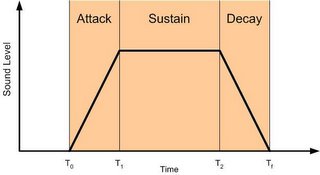
Figure 1 - Life of a Note (Envelope)
Sustaining a note
The length of the note is simply controlled by how long you blow the note. It starts from the beginning of the attack until the end of the decay. Blow for a short time and you have a short note, blow for a long time and you have long note. Don’t forget that the length of the note is the one of the most important variables that you have in composing interesting music.
Volume Control
The volume of the note is controlled by how hard you blow into the flute. Blow hard and the note will be loud. Blow soft and the note will be quiet. If you blow too hard, you will likely produce a high-pitched squeal, this is called overblowing (we'll take about Overblowing in a future post) and is not desirable unless you do it on purpose.
This Playing Tip is licensed under a Creative Commons Attribution-NonCommercial-ShareAlike 2.5 License.
Just like our lives have a beginning, middle and an end, each note lives its life in the same way. There are some simple terms that describe the different periods of a note’s life (see Figure 1). The initial part of a note’s life is called the Attack; this period is from the point at which you start blowing until the note reaches full volume. The middle part of the note’s life is called the Sustain and this lasts from the end of the attack, until the beginning of the last part of the note that is called the Decay. The Decay is the period in which the note drops in volume until the sound stops. The Decay can anything from a long, slow decrease in volume to a very quick drop (or stopping) of the sound. Many times, the Sustain and Decay will overlap and it may be difficult to define the exact transition from Sustain to the Decay. We'll use these terms to help define the different ornamentation techniques that make this instrument produce such beautiful music.

Figure 1 - Life of a Note (Envelope)
Sustaining a note
The length of the note is simply controlled by how long you blow the note. It starts from the beginning of the attack until the end of the decay. Blow for a short time and you have a short note, blow for a long time and you have long note. Don’t forget that the length of the note is the one of the most important variables that you have in composing interesting music.
Volume Control
The volume of the note is controlled by how hard you blow into the flute. Blow hard and the note will be loud. Blow soft and the note will be quiet. If you blow too hard, you will likely produce a high-pitched squeal, this is called overblowing (we'll take about Overblowing in a future post) and is not desirable unless you do it on purpose.
This Playing Tip is licensed under a Creative Commons Attribution-NonCommercial-ShareAlike 2.5 License.
Wednesday, December 07, 2005
Holiday Gift Guide: Winter Dreams CD

If you're looking for a great 'classic' Native American Flute Christmas CD, I highly recommend Winter Dreams by R. Carlos Nakai and William Eaton. I just pulled out my holiday music collection to get into the holiday spirit and I always love this CD. The CD features some classic Christmas melodies arranged for the Native American flute and stringed instruments. I would say guitar, except that William Eaton doesn't play your average guitar. He is one of the world's greatest designers and builders of unique stringed instruments. Many of his instuments have 30+ strings on them which makes it sound like there is more than one guitarist playing. Of course I don't need to say anything about Nakai's skill on the Native American Flute, it's pure magic. This is an instrumental CD, and it's one that I am sure will remain at the top of your holiday music hitlist (or even year round).
Tuesday, December 06, 2005
New Peter Mayer Christmas CD Coming
I just heard from Mark Holland that the new Peter Mayer Christmas CD will be available within the the next week. The name of the new CD is "Echos of the Season" and features the following folks: Jim Mayer on bass, R. Scott Bryan on percussion, Mark Holland on flute, Emily Randle on violin, Melissa Streuli on violin, Gary Hodges on cello, as well as guest appearances from Mac McAnally on vocals and guitar, Roger Guth on drums, Chris Walters on piano, Jon Nellen on tabla, as well as Tina Gullickson and Nadirah Shakoor on vocals. You can find more information, including a complete track listing on Peter's Website.
Mark and Peter collaborate on each others music, in fact Mark is on tour through December 18th with Peter's Stars and Promises tour. Mark plays Native American flute on Peter's CD's and Peter plays guitar on Mark's CD's. Peter is a member of August Child. Mark had mentioned the upcoming Christmas CD when he was out on tour this fall.
 To get a taste of Peter's music you can download the track "Faith in Angels" off of Peter's latest album Musicbox from Peter's website . Faith in Angels is a great tune, with a rock feel with acoustic and electric guitar, bass and drums. I can't admit to listening to much of Peter's music outside of Autumn's Child, but I sure love his guitar playing on Authumn's Child albums.
Monday, December 05, 2005
FREE: Stanford Lectures and music on iTunes
 I discovered some very cool content on iTunes, published by Stanford University. Stanford is experimenting with the idea of publishing content on iTunes, since the majority of the student population has iPods or other MP3 music players. You do need to have iTunes installed on your PC or MAC, but you don't need an iPod to listen to the content, you can listen to the content through iTunes on you computer. Stanford is publishing faculty lectures, featrured speakers, keynote presentations, school sporting events and student produced music on iTunes. And the best part is that it's all free!!
In the music department, Stanford Chamber Chorale and Orchestra is featured this month with a Christmas music theme. There are 12 tracks of Christmas songs that you can download for free. You can also download and listen to student produced tracks.
Check it out here.
Subscribe to:
Posts (Atom)